Same-Day Scheduling
Wilmington, DE & the Brandywine Valley
Emergency Foreign Body Removal for Dogs in Wilmington, DE
Urgent, life-saving abdominal surgery to remove swallowed objects from a dog's stomach or intestinal tract.
- 30-40% below referral hospitals
- Scheduled within days
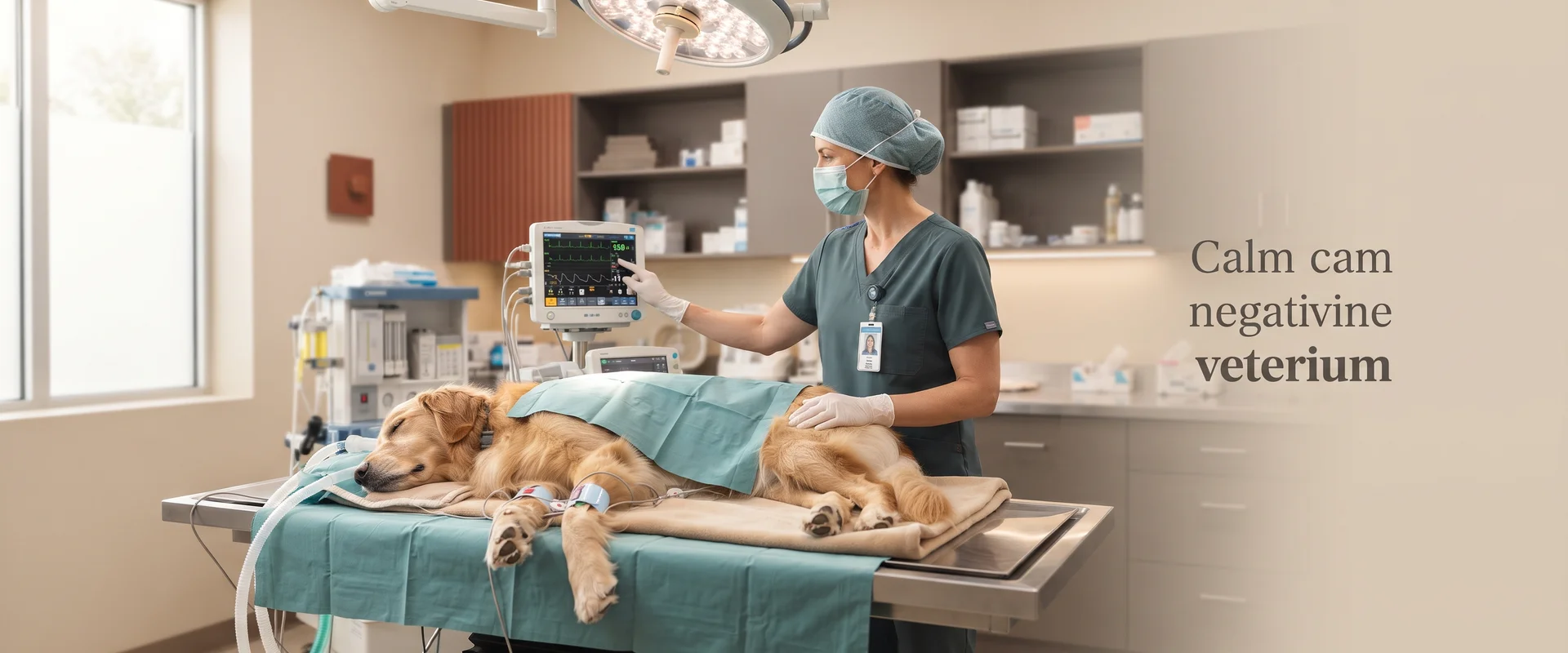
- Full anesthetic monitoring
Starting Price
$1,200
Credential 01
4.9★ Google (150+ reviews)
Credential 02
Surgery Within Days
Credential 03
30-40% Below Referral Hospitals
Credential 04
Pre-Anesthetic Bloodwork & Full Monitoring
What is foreign body removal surgery?
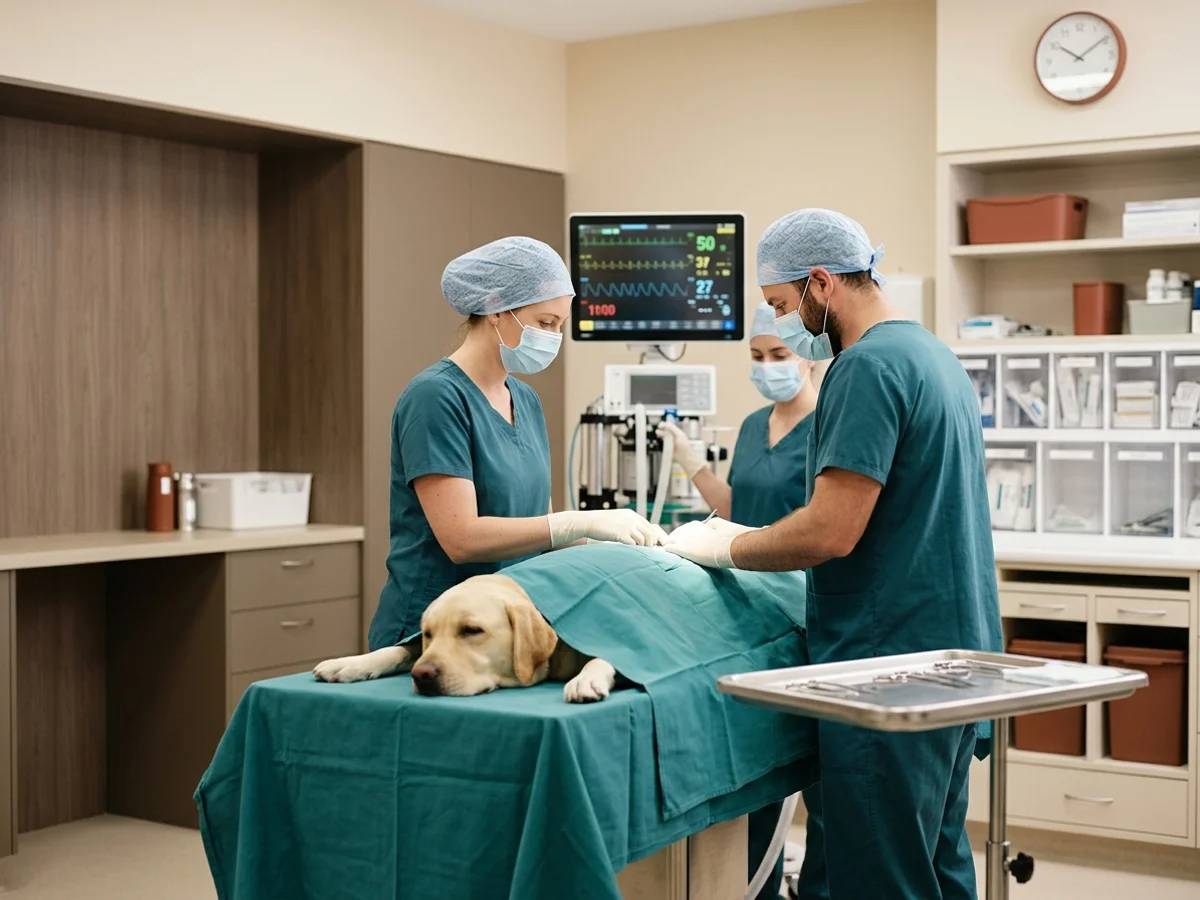
Brandywine Valley Dog Surgery performs foreign body removal - a canine soft tissue surgery to extract something your dog swallowed that cannot pass on its own. From our Wilmington, DE surgical network, we schedule these cases within days rather than the four-to-six-week wait at corporate referral hospitals. Socks, chew toys, corn cobs, cooked bones, rocks, and string account for most of what we take out, making this the single most common emergency pet surgery in the region and the one where the gap between acting today and waiting a week matters most.
An object sitting in the stomach is usually the manageable version. Once it moves into the small intestine it creates an intestinal obstruction, and that obstruction does two things at once: it stops anything passing, and it presses on the bowel wall until the blood supply to that section fails. Dead bowel has to be removed. That is the difference between a straightforward enterotomy and a resection and anastomosis, and the variable separating them is very often time.
When does your dog need emergency surgery?
Call us immediately if your dog is showing any of these after swallowing something:
- Repeated vomiting, especially vomiting that will not stop even for water
- Refusing food, or eating and immediately bringing it back up
- Lethargy, hiding, or a hunched, uncomfortable posture
- Straining to defecate with nothing produced
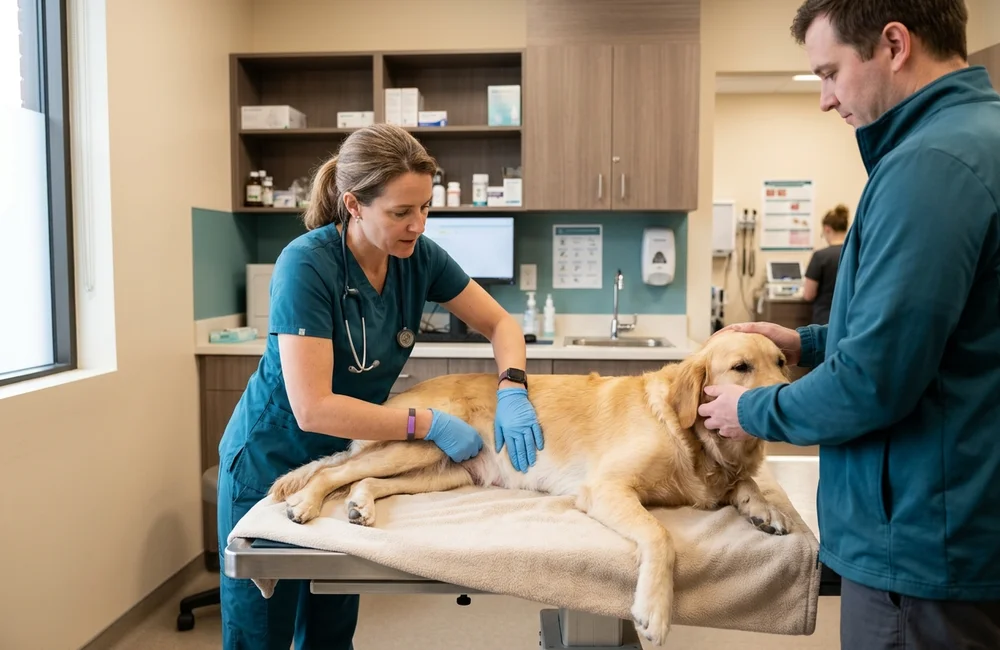
- A tense, painful abdomen that your dog does not want touched
- Any swallowed string, thread, tinsel, or ribbon - this is urgent regardless of symptoms
Do not induce vomiting before calling us
Bringing a corn cob or a bone fragment back up can tear the esophagus, and a linear foreign body must never be moved. Call first. It takes two minutes and it changes the plan.
What happens during gastrotomy or enterotomy?
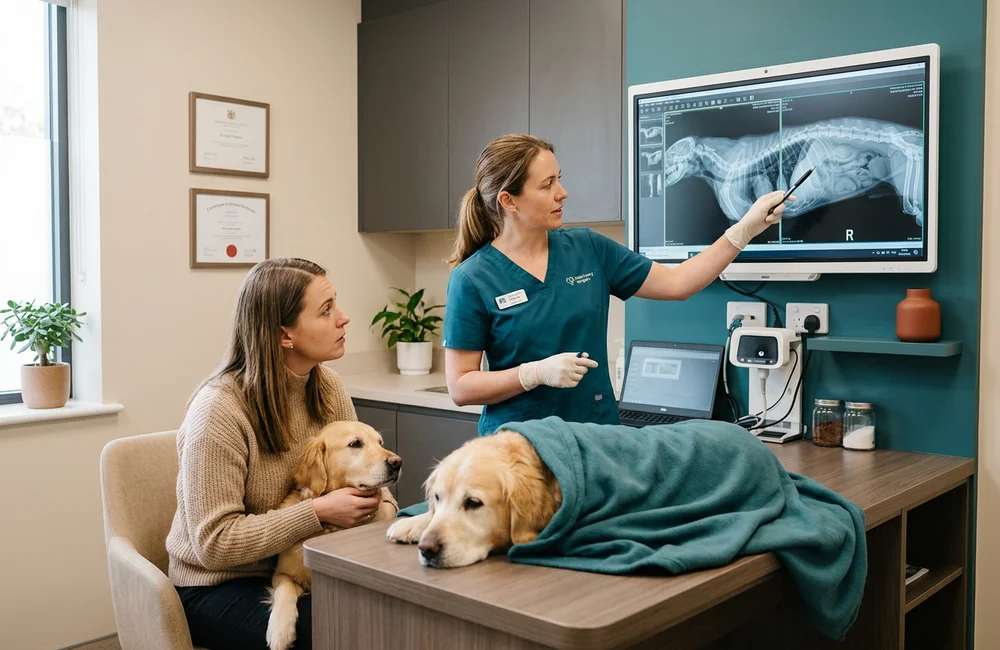
Every case starts with pre-op abdominal radiography (X-rays). Rocks and most bones are radiopaque and show clearly. Fabric, rubber, and plastic often do not, so we read the pattern instead: gas distension proximal to an obstruction, plicated bowel loops that suggest a linear foreign body, or free fluid that suggests a perforation. Where radiographs are inconclusive, abdominal ultrasound resolves it.
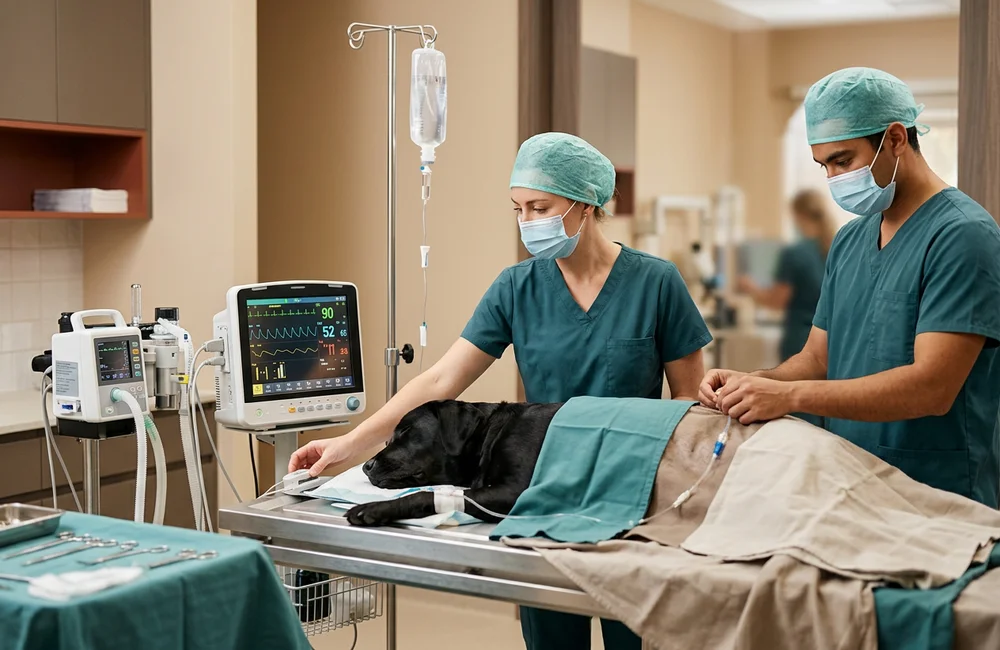
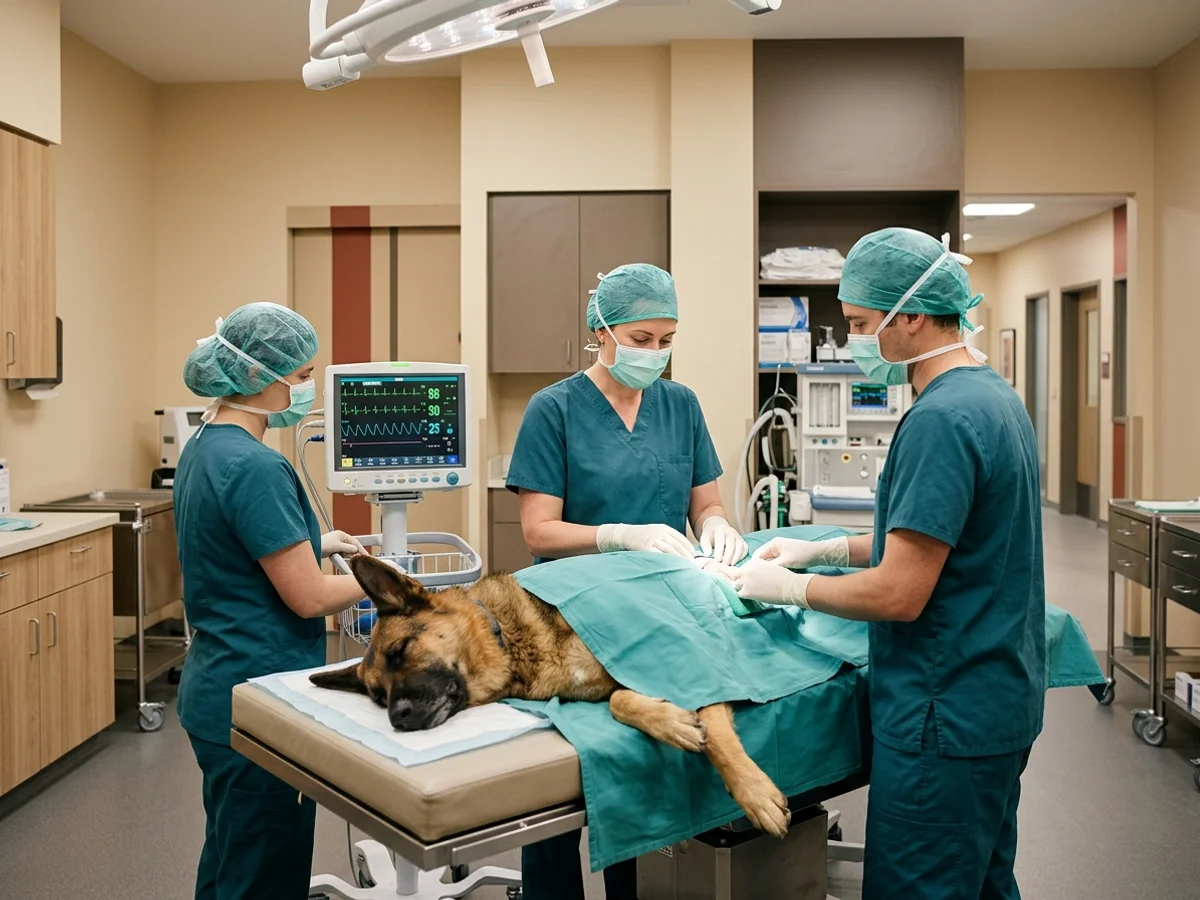
Dogs that have been vomiting for a day or more arrive dehydrated with disturbed electrolytes, so IV fluid resuscitation comes before anesthesia rather than after it. Your veterinary surgeon then opens through a midline linea alba incision, which gives access to the whole abdomen with minimal muscle trauma.
A gastrotomy opens the stomach. An enterotomy opens the affected loop of intestine. In either case we remove the object, then run the entire length of the tract by hand, because dogs that swallow one thing have frequently swallowed two. Where a section of bowel is devitalised, or where an intussusception has telescoped one segment into another, intestinal resection and anastomosis removes the damaged portion and joins the healthy ends.
| Gastrotomy | Enterotomy | Resection & anastomosis | |
|---|---|---|---|
| Where we open | The stomach | The affected loop of intestine | The damaged segment, which is removed |
| When it applies | Object still sitting in the stomach | Object lodged in the intestine, bowel healthy | Bowel already devitalised, or an intussusception |
| Relative complexity | Lowest | Moderate | Highest - healthy ends must be rejoined |
| What decides it | How far the object has travelled | How far the object has travelled | How long the obstruction has been in place |
| Owner-controlled factor | Calling the same day | Calling the same day | Delay is what pushes a case into this column |
Closure is done in layers, with cefazolin cover and abdominal lavage where contamination has occurred. Peritonitis prevention is the whole game here: the danger in intestinal surgery is not the incision, it is leakage from the closure afterwards.
How we compare
| Feature | Typical Emergency Hospital | Brandywine Valley Dog Surgery |
|---|---|---|
| Scheduling | 4-6 week wait | Within days, same-day for emergencies |
| Starting price (gastrotomy) | $3,000-$5,000 | From $1,200 (2026) |
| Pre-op radiographs | Billed separately | Included |
| IV fluid support | Billed separately | Included |
| Post-op support | Office-hours callbacks | 24/7 recovery text line |
| Healing evaluation | Additional visit fee | Complimentary at 10-14 days |
What to expect during recovery
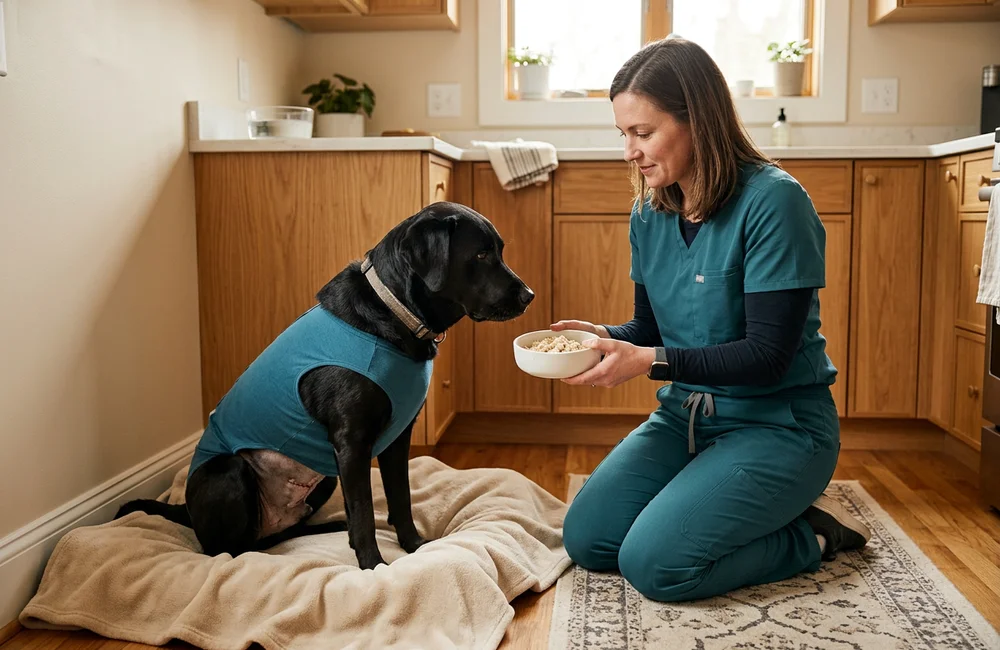
Food comes back slowly. Small, frequent, bland meals for the first several days, then a gradual return to normal food across the second week. Water is offered in small amounts often rather than a full bowl at once. Activity is restricted for the full two weeks.
Call our Wilmington surgical team straight away if your dog starts vomiting again, refuses food after initially eating, becomes lethargic, or if the incision swells, reddens, or leaks. The 24/7 post-op recovery text line exists precisely for the 2am version of that question.
How to prevent your dog from swallowing objects
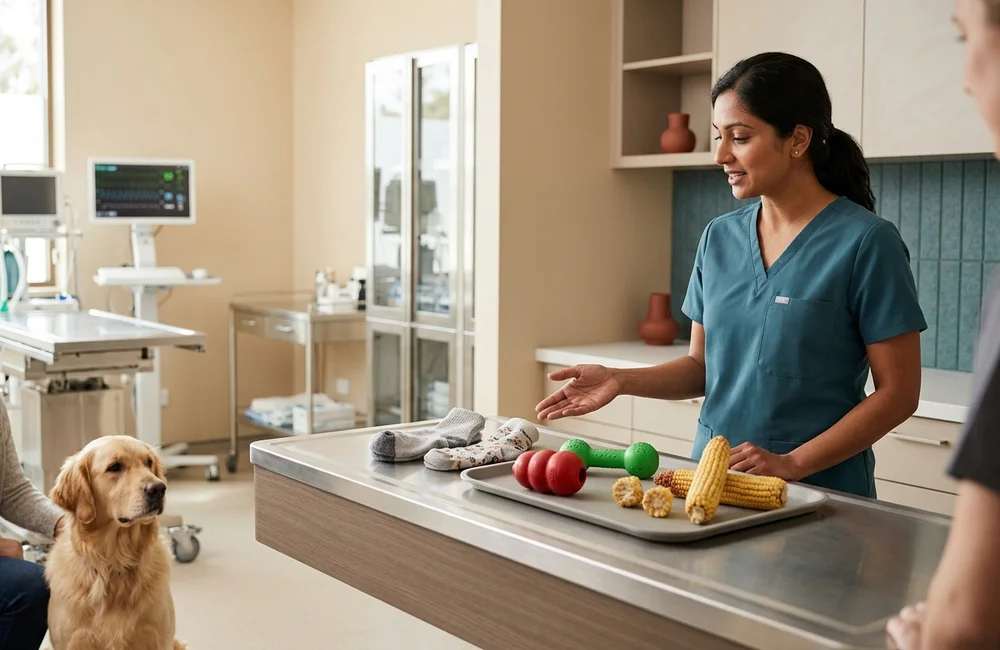
The objects change with the season. Cookout scraps - corn cobs, cooked bones, skewers - spike from June through October across Brandywine Hundred, Hockessin, Greenville, and the wider New Castle County and Delaware County corridors. Socks and children’s toys are year-round. Rocks belong to a specific type of young dog and rarely stop at one.
If your dog is a repeat offender, the practical measures are dull but effective: a closed laundry basket, supervised chew time with size-appropriate toys, and a firm household rule about plates left within reach. If it has already happened, our Wilmington surgical team would rather hear from you an hour too early than a day too late. Read the full dog foreign body surgery cost guide for Wilmington for a detailed price walkthrough.
Price Ledger
How much does foreign body removal cost?
A straightforward gastrotomy sits at the bottom of the range (2026 pricing). Intestinal cases needing resection and anastomosis, and dogs that arrive septic, cost more.
Starting From
$1,200
starting, including pre-op abdominal radiographs and IV fluid support
Included in the price
- Pre-op abdominal radiographs
- Pre-anesthetic blood screening
- IV fluid resuscitation and support
- Gastrotomy or enterotomy with careful closure
- Perioperative antibiotics and pain control
- Home-recovery medications, discharge checklist, and healing evaluation
Quoted separately
- Abdominal ultrasound where radiographs are inconclusive
- Intestinal resection and anastomosis for devitalised bowel
- Extended inpatient care for septic cases
Nothing gets added to your bill without your approval first. Ask for the written estimate before you commit.
We accept cash, credit card, and CareCredit financing. If cost is the barrier to treating your dog, tell us when you request a booking.
Free Tool
Try our Dog Surgery Cost Estimator
Estimate the cost of your dog's surgery and see how much you could save versus a corporate referral hospital.
Why Us For This Surgery
Why owners choose us for foreign body removal
01
Same-day scheduling when time is the variable
An obstruction that is operated on today is a different, safer, cheaper surgery than the same obstruction on Friday. We treat these calls as the emergency they are.
02
Radiographs and IV support in the starting price
Emergency hospitals itemise imaging and fluids separately, and the total climbs fast. Ours are included in the $1,200 starting figure.
03
Linear foreign bodies taken seriously
String and thread saw through and bunch the intestine. We never pull a visible string, and we check the entire tract rather than stopping at the first object we find.
04
Peritonitis prevention built into the closure
The real danger in intestinal surgery is leakage after closure. Careful layered closure, cefazolin cover, and lavage where indicated are how we manage it.
Procedure Ledger
How foreign body removal works
What happens from your first booking request through to your dog's follow-up evaluation.
Step 01
Call us the moment you know
Tell us what your dog swallowed, when, and what symptoms you are seeing. We triage foreign body calls ahead of everything else because timing changes the surgery.
Step 02
Imaging and stabilisation
Pre-op abdominal radiographs locate the object where it is visible and show the pattern of gas and fluid where it is not. IV fluids correct the dehydration that repeated vomiting causes.
Step 03
Gastrotomy or enterotomy
We open the stomach or the affected section of intestine through a midline linea alba incision, remove the object, check the rest of the tract, and close in layers.
Step 04
Recovery and diet transition
Your dog stays under observation until stable, then goes home on a bland diet reintroduced gradually, with medications and a 24/7 recovery text line.
Need foreign body removal for your dog?
Send us the details and we will confirm honest pricing and the soonest surgical date, usually within days.
Deeper Reading
Foreign Body Removal guides
Plain-language answers to the questions owners ask before booking this surgery.
scenario
Dog Ate a Bone: Surgery, Signs, and Cost
Bones can splinter, obstruct, or perforate a dog's gut. Learn urgency signs, surgery cost in Wilmington DE, and when to seek help.
Read guideprocess
Dog Foreign Body Surgery Recovery Timeline
A day-by-day recovery timeline after your dog's foreign body surgery: diet transition, incision care, activity limits, and warning signs.
Read guidecost
Dog Foreign Body Surgery Cost in Wilmington, DE
Full walkthrough of canine foreign body surgery, honest Wilmington DE cost guide, urgency framing, FAQ, and same-day booking.
Read guidedefinition
Dog Gastrotomy vs Enterotomy: How Foreign Body Surgery Works
How canine foreign body surgery works: stomach (gastrotomy) vs intestinal (enterotomy) approach, linear foreign body risk, and resection.
Read guidescenario
Dog Swallowed a Corn Cob: Surgery, Signs, and Cost
Corn cobs rarely pass and often obstruct a dog's intestine. Learn urgency signs, surgery cost in Wilmington DE, and when to act.
Read guidescenario
Dog Swallowed a Rock: Surgery, Signs, and Cost
Rocks show clearly on X-ray and often obstruct a dog's gut. Learn urgency signs, surgery cost in Wilmington DE, and when to act fast.
Read guidescenario
Dog Swallowed a Sock: Surgery, Signs, and Cost
Your dog swallowed a sock? Learn the obstruction risk, urgent warning signs, surgery cost in Wilmington DE, and when to call now.
Read guidescenario
Dog Swallowed String: Linear Foreign Body Surgery and Cost
String and thread are especially dangerous linear foreign bodies in dogs. Learn the plication risk, urgency signs, and surgery cost.
Read guidescenario
Dog Swallowed a Toy: Surgery, Signs, and Cost
Balls and chew toys can block a dog's gut. Learn the urgency signs, foreign body surgery cost in Wilmington DE, and when to call.
Read guideconcern
Signs of Intestinal Blockage in Dogs: When Surgery Is Needed
Vomiting, refusing food, lethargy, straining: the red-flag signs of a dog intestinal blockage and when surgery is urgent.
Read guideFrom the Practice Journal
Real foreign body removal cases and safety standards
Case write-ups and practice updates covering what owners most often want reassurance about.
Sep 8, 2026
Cookout Season Warning: The Fall Foreign-Body Risks We See Most in the Brandywine Valley
Corn cobs, bones, and skewers spike during late-summer and fall cookouts. What Brandywine Valley dog owners should watch for and when surgery is needed.
Read postAug 26, 2026
Same-Week Surgery: How a Wilmington Retriever Recovered After Swallowing a Sock
A Wilmington DE dog owner faced a six-week ER wait after their retriever swallowed a sock. Here's how our network operated within days and what recovery looked like.
Read postOwner Ledger
What owners say about our foreign body removal
Rated 4.9 across 150+ reviews from dog owners across the Brandywine Valley.
Review 01
“Our lab swallowed a sock on a Saturday and they had him in surgery within days, not the six-week wait we were quoted elsewhere. The pre-op bloodwork and monitoring put us at ease.”
Meghan R.
Wilmington, DE
Review 02
“Our beagle got into the cookout scraps. We were told six weeks by one hospital. These folks had him in surgery that week and walked us through every step of the recovery.”
Greg H.
Glen Mills, PA
Review 03
“Everyone else told us to wait weeks. Our puppy had swallowed a rock. They saw the X-ray, gave us a straight price, and operated within days.”
Marcus O.
Middletown, DE
Service FAQ
Foreign Body Removal questions
01How much does dog foreign body surgery cost in Wilmington, DE?
From around $1,200, and that figure already includes the pre-op abdominal radiographs, pre-anesthetic blood screening, IV fluid support, anesthesia with continuous monitoring, the surgery itself, and post-operative medications. Emergency and referral hospitals in the Christiana corridor routinely quote $3,000 to $5,000 for the same procedure. What pushes our price up is complexity: a linear foreign body that has damaged a section of intestine may need resection and anastomosis, and a dog that arrives septic needs more intensive support.
02My dog just swallowed something. Is this an emergency?
Treat it as one. Call us immediately rather than waiting to see what happens. Red flags that mean act now: repeated vomiting, refusing food or water, lethargy, straining without producing stool, a hunched posture, or a painful abdomen. Some small smooth objects do pass, but you cannot tell which from the outside, and an obstruction that has been sitting for two days is a far more dangerous operation than one caught the same day.
03Should I make my dog vomit at home?
No. Call us first. Inducing vomiting can make some obstructions dramatically worse. A sharp bone fragment or a corn cob coming back up can tear the esophagus, and a linear foreign body should never be moved. There are situations where induced vomiting is the right call, but that decision needs to be made by a vet who knows what was swallowed and when.
04What is the difference between a gastrotomy and an enterotomy?
A gastrotomy opens the stomach; an enterotomy opens the small intestine. Which one your dog needs depends entirely on where the object has lodged. Objects still in the stomach are generally the better scenario. The stomach heals well and has an excellent blood supply. Once an object has moved into the intestine it can obstruct, and if it has been there long enough to compromise the blood supply, that section of bowel has to be removed and the ends joined, a resection and anastomosis.
05Why is string more dangerous than a solid object?
A linear foreign body anchors at one end, usually under the tongue or at the pylorus, while the intestine keeps trying to move the rest along. The intestine bunches up on the string like fabric on a thread, and the taut string saws through the bowel wall from the inside. This causes multiple perforation points and peritonitis. Never pull on a visible string, and call us the moment you suspect one.
06Will a rock or a bone show up on an X-ray?
Rocks and most bones are radiopaque, so they usually appear clearly on abdominal radiographs. Fabric, rubber, and plastic frequently do not, which is why we read the surrounding pattern (gas distension, a plicated bowel loop, or fluid accumulation) rather than looking only for the object. Where radiographs are inconclusive, abdominal ultrasound gives us the answer.
07How long is recovery after foreign body surgery?
About two weeks. Food is reintroduced gradually over the first several days, starting with small, frequent, bland meals rather than a normal portion. Activity is restricted for the full fortnight while the abdominal incision and the gut closure heal. The signs that need an immediate call are renewed vomiting, refusal to eat, a swollen or oozing incision, lethargy, or a painful abdomen.
08How quickly can you operate?
Within days as standard, and same-day when the clinical picture is time-critical. This is the core reason owners in Wilmington, Newtown Square, and Newark come to us. Coordinating across a network of surgical calendars means we are not limited to whatever slot one building happens to have free.
09What is the success rate of foreign body surgery in dogs?
Prognosis is strongly tied to timing. A dog that reaches surgery within 24 hours of swallowing an object, before the bowel loses blood supply, has an excellent outlook. The risk climbs when obstruction has been present long enough to cause devitalized bowel or peritonitis, which is why we schedule these cases within days and treat same-day requests as the emergency they are.
10Can a foreign body be removed from a dog without surgery?
In some cases endoscopy can retrieve objects still sitting in the stomach, but it cannot reach the small intestine where most obstructions cause damage. Endoscopy also requires general anesthesia, the same as surgery. At Brandywine Valley Dog Surgery, we evaluate every case on X-rays first and will tell you if a non-surgical option exists. Most cases that reach us have already moved past the point where endoscopy is viable.
Still have questions about your dog?
Send us the details and we will come back with a straight answer, an honest price, and the soonest surgical date we can offer.
Request Surgery BookingCross Reference
Related surgeries
Urgent surgeries scheduled within days
Ready to book foreign body removal?
Honest pricing, full anesthetic monitoring, and a surgical date in days. Serving Wilmington DE, Newtown Square PA, and Newark DE.
- 30-40% below referral hospitals
- Scheduled in days, not weeks
- Full monitoring on every case