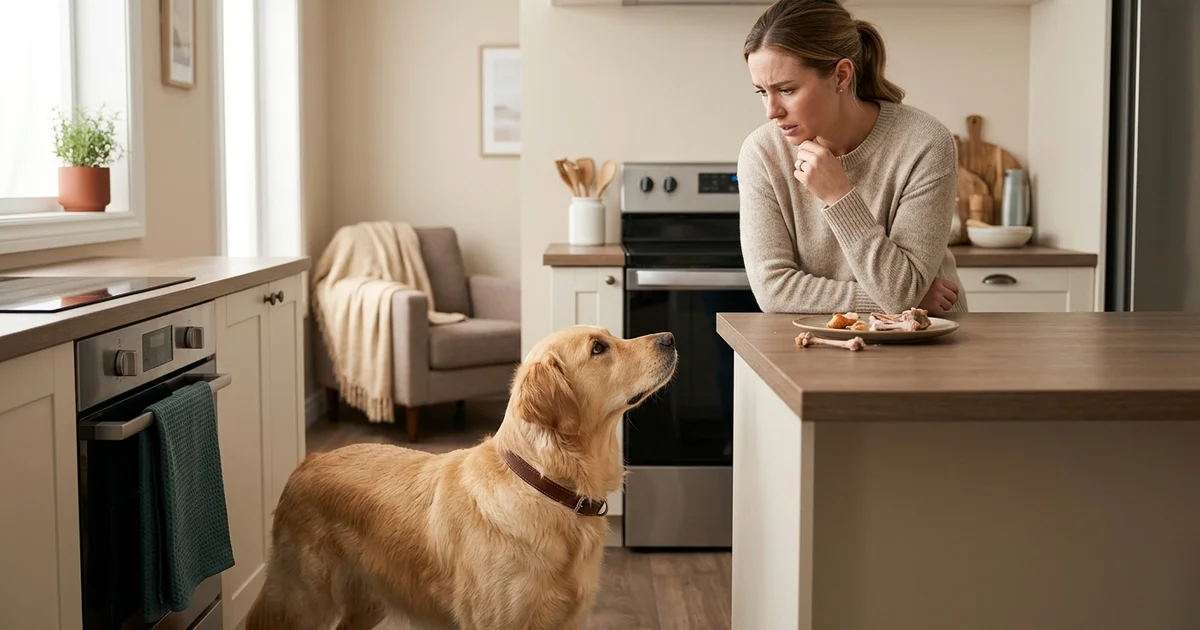
Bones are a different kind of risk
Most swallowed objects cause one problem: they obstruct. Bones can cause three.
They can obstruct, like anything else that lodges. They can splinter into sharp fragments that damage the gut wall on the way through. And they can perforate, punching through the stomach or intestinal wall and spilling contents into the abdominal cavity — which causes peritonitis, a genuinely life-threatening infection.
That third possibility is why we take bone calls seriously even from dogs who look fine. Our foreign body removal surgery treats these as priority assessments.
Cooked versus raw
Cooking changes bone structurally. It dries out the collagen that gives raw bone its slight flexibility, and what remains is brittle. Under a dog’s molars a cooked bone does not grind down; it shatters, producing fragments with genuine points and edges.
Chicken, turkey, pork chop, and rib bones are the ones we see most, and cookout and holiday leftovers are the classic source. Small poultry bones are especially deceptive, because owners assume something that small must be harmless.
Raw bones are a different conversation with its own risks, but the splintering hazard is much lower.
Never induce vomiting after a bone.
Sharp fragments coming back up can lacerate the esophagus, which is a considerably worse injury than the original problem.
Signs to watch for
Bones can cause problems at any point along the tract, so the signs vary depending on where the fragment is:
- Retching or repeated swallowing — a fragment in the throat or esophagus
- Vomiting, refusing food, lethargy — obstruction in the stomach or intestine
- A tense, painful abdomen with fever — possible perforation, an emergency
- Straining, hard or bloody stool, painful defecation — fragments passing through the colon
- Dark, tarry stool — bleeding higher in the tract
The last two often get dismissed as constipation. A dog straining painfully after eating bones is not constipated in the ordinary sense and should be seen.
Diagnosis is more straightforward with bone
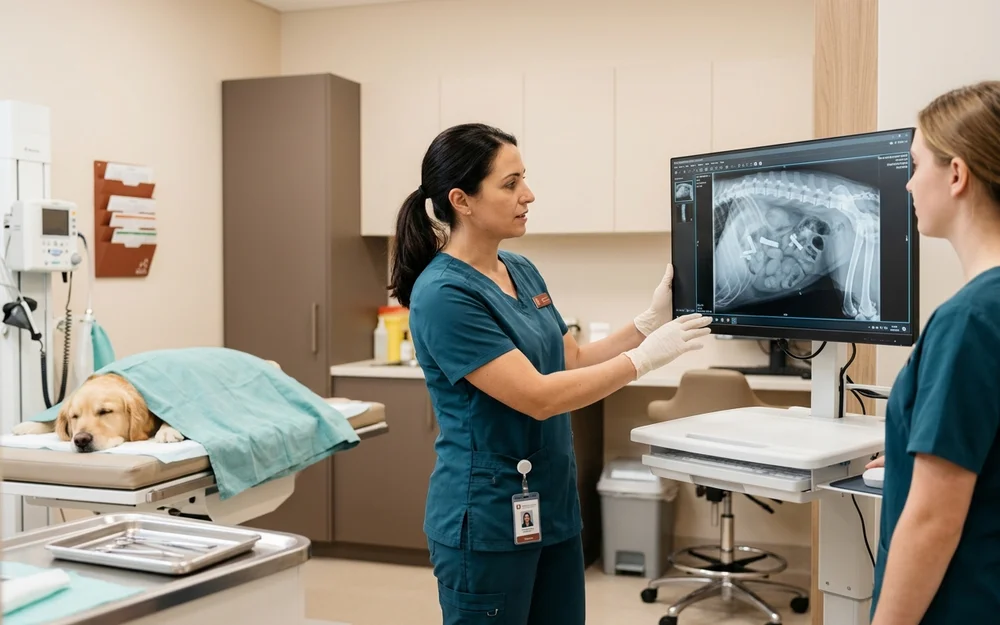
Unlike fabric or rubber, bone is radiopaque and shows clearly on abdominal radiographs. We can usually see the fragments, count them, and locate them.
What the films also show is the consequence: gas patterns indicating obstruction, or — the finding we are most concerned about — free gas in the abdomen, which indicates a perforation and means immediate surgery.
Cost and what happens next
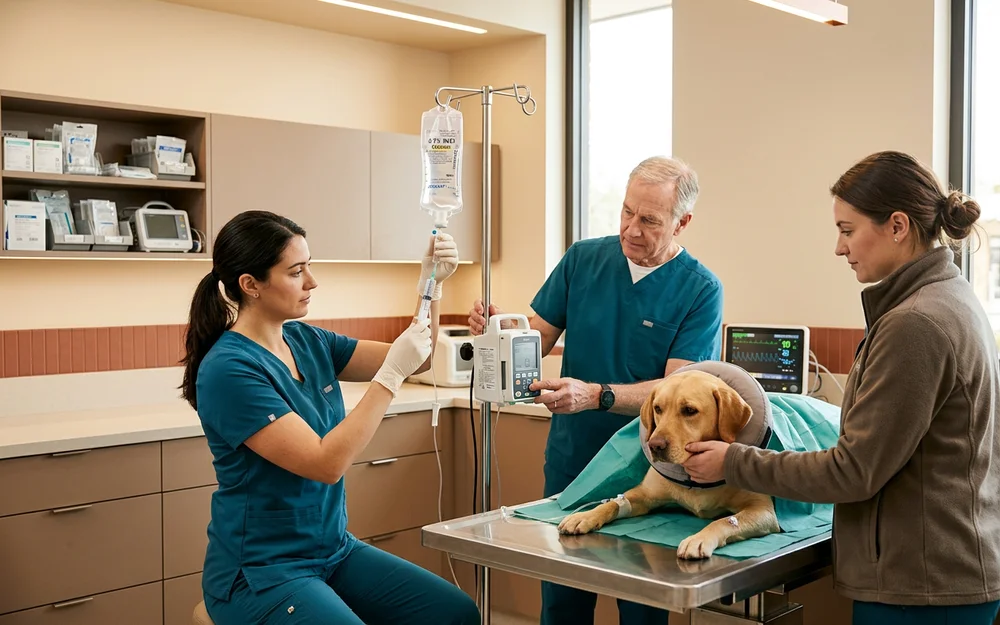
Removal starts at $1,200 including pre-op radiographs, pre-anesthetic bloodwork, IV fluid support, anesthesia with continuous monitoring, the surgery, and post-operative medications.
Where a perforation has already occurred, the surgery involves repairing the defect and thorough abdominal lavage to clear contamination, plus broad-spectrum antibiotic cover. Those cases need more support and cost more, which is the strongest argument for being seen early rather than waiting to see whether things settle.
What to do now
If your dog has a rigid, painful abdomen, a fever, is collapsing, or cannot keep water down, go to your nearest emergency hospital immediately — perforation and peritonitis need stabilisation without delay.
Otherwise contact us now with your dog’s breed and weight, what type of bone was eaten, whether it was cooked, roughly how much, and when. We will tell you honestly whether this needs imaging today or whether careful observation is reasonable.
And the practical prevention: lidded bins, plates cleared straight to the kitchen, and a firm word with anyone inclined to slip the dog a scrap under the table.