
Socks are the classic, and the reason is anatomy
Socks are among the most common objects we remove from dogs in the Brandywine Valley, and they are common for two reasons: they smell overwhelmingly of the person the dog loves, and they are always at floor level.
The reason they cause so much trouble is that fabric feels harmless. It is soft, it squashes, and owners reasonably assume something that compresses in your hand will compress through a gut. What actually happens is that a sock balls up as the stomach churns it, then travels into the small intestine as a dense wad and wedges.
Our foreign body removal surgery sees more socks than any other single object.
What happens if it is not removed
A lodged sock does two things. It blocks the passage of food and fluid, which is why vomiting starts. And it presses continuously against the bowel wall from the inside, which progressively cuts off the blood supply to that segment.
Once that tissue dies, the surgery changes. Instead of a small incision to remove the object, the damaged section of intestine has to be cut out entirely and the healthy ends joined — a resection and anastomosis. Longer, riskier, more expensive.
The variable is time, not luck.
A sock removed today is often a straightforward procedure. The same sock on Friday can be a resection.
The signs to watch for
Symptoms usually appear within 24 hours but can be delayed if the sock sits in the stomach for a while first:
- Repeated vomiting, especially vomiting that continues even for water
- Refusing food, or eating and immediately bringing it up
- Lethargy, hiding, or a hunched posture
- Straining to defecate with nothing produced
- A tense abdomen your dog does not want touched
- Drooling or repeated swallowing
Do not induce vomiting without calling us first. A sock coming back up can lodge in the esophagus, which is a considerably worse problem than one in the stomach.
Why the X-ray may look normal
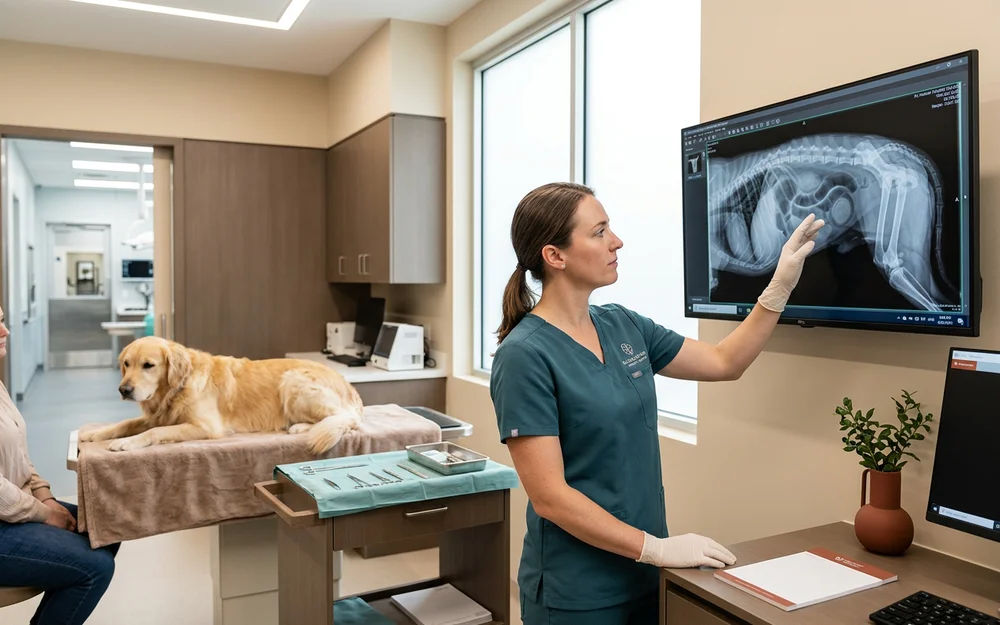
Fabric is radiolucent — it does not show up on a radiograph the way a stone or a bone does. Owners are sometimes told the X-ray was clear and go home reassured.
What we look for instead is the pattern the sock creates: gas building up behind the obstruction, loops of intestine distended where they should be flat, and an abrupt change in bowel diameter. That pattern is readable to anyone who looks at abdominal films regularly. Where it is ambiguous, abdominal ultrasound gives the answer.
The surgery and the cost
Foreign body removal starts at $1,200, and that figure includes the pre-op abdominal radiographs, pre-anesthetic blood screening, IV fluid support, anesthesia with continuous monitoring, the surgery itself, and post-operative medications.
A sock still in the stomach means a gastrotomy, which is the more straightforward version. A sock in the intestine means an enterotomy. Either way we run the entire intestinal tract by hand afterwards, because dogs who eat one sock have very frequently eaten two.
Emergency and referral hospitals in the Christiana corridor commonly quote $3,000 to $5,000 for the same operation.
What to do right now
If your dog is collapsing, cannot keep water down, or has a rigid painful abdomen, go to your nearest emergency hospital for stabilisation first.
Otherwise, call us now. Tell us the breed and size of your dog, roughly when the sock was swallowed, what size it was, and what symptoms you are seeing. We triage foreign body calls ahead of routine work and schedule urgent cases within days, same day when the picture is time-critical.
Bring the matching sock if you have it. Knowing the exact size genuinely helps.