
Why this is urgent rather than concerning
An intestinal blockage is not a condition that gets slowly worse over a week. It is a condition where the clock starts the moment the object lodges.
Something stuck in the small intestine presses against the bowel wall from the inside. That pressure compromises the blood supply to that section, and tissue without blood supply dies. Dead bowel cannot simply be opened and closed — it has to be removed, and the healthy ends joined. That is a longer surgery, a riskier one, and a substantially more expensive one.
Our emergency foreign body surgery is scheduled around exactly that timeline, which is why we triage these calls ahead of routine work.
The red-flag signs
Call us if your dog shows any of these, whether or not you saw them swallow something:
- Repeated vomiting, especially vomiting that continues even for water
- Refusing food, or eating and immediately bringing it back up
- Lethargy — hiding, unwilling to move, not greeting you at the door
- Straining to defecate with nothing produced, or passing only small amounts of liquid
- A hunched posture or a “praying” position with the front down and rear up
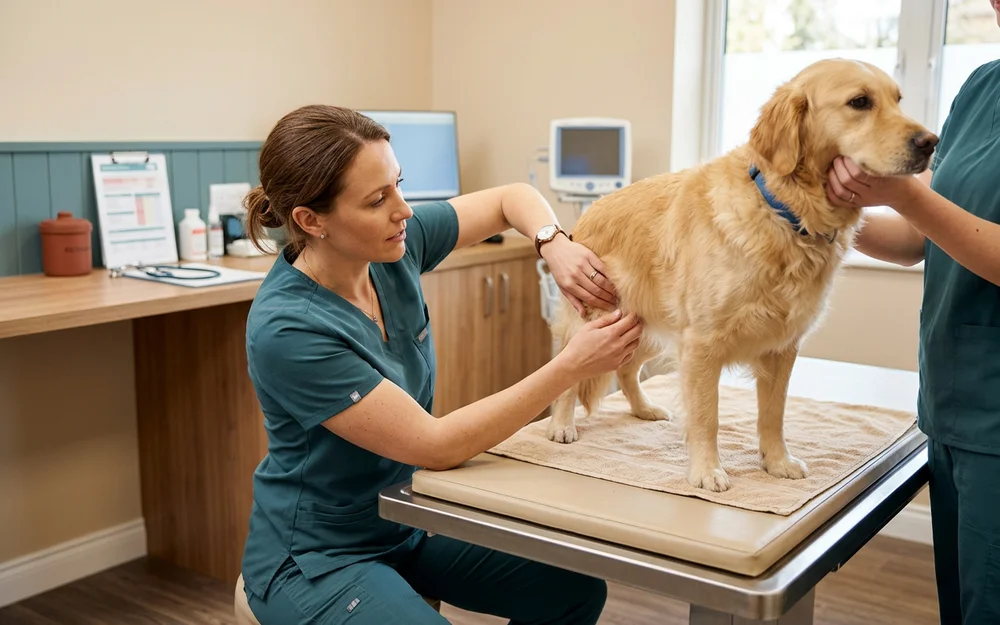
- A tense, painful abdomen your dog does not want touched
- Dark, tarry, or bloody stool
- Drooling or repeated swallowing without producing anything
The dangerous middle ground
The genuinely difficult case is the dog who is slightly off but not dramatically ill. They vomited twice this morning and are now lying quietly. They ate a little dinner. Nothing is obviously wrong.
Owners understandably wait to see how things develop. Meanwhile the object sits where it is, the pressure continues, and the window for the simpler operation closes.
The single most expensive decision available to you is waiting.
An obstruction operated on today is frequently a $1,200 procedure. The same obstruction on Friday can need resection, longer anesthesia, and intensive aftercare.
If your dog is off after swallowing something, or off with no explanation and behaving like this, the appropriate response is a call rather than a night of observation.
What we do first
Diagnosis starts with abdominal radiographs. Rocks and most bones show up clearly. Fabric, rubber, and plastic frequently do not — which is why the films are read for the pattern rather than the object. Gas distension proximal to an obstruction, loops of bowel distended where they should be flat, plicated loops that suggest a linear foreign body, or free fluid suggesting a perforation all tell the story.
Where radiographs are inconclusive, abdominal ultrasound resolves it.
Dogs who have been vomiting for a day arrive dehydrated with disturbed electrolytes, so intravenous fluid support comes before anesthesia, not after it.
Partial versus complete obstruction
A complete obstruction allows nothing through. These dogs deteriorate quickly and are unmistakably ill.
A partial obstruction allows liquid past but not solids. These dogs are the confusing ones — they vomit intermittently over days, may pass some stool, and can seem to improve between episodes. Partial obstructions still damage the bowel wall, and they still need surgery. Owners often report their dog was “up and down for a week” before presenting.
What to do right now
If your dog is collapsing, cannot keep water down, or has a rigid, painful abdomen, go to your nearest emergency veterinary hospital immediately for stabilisation.
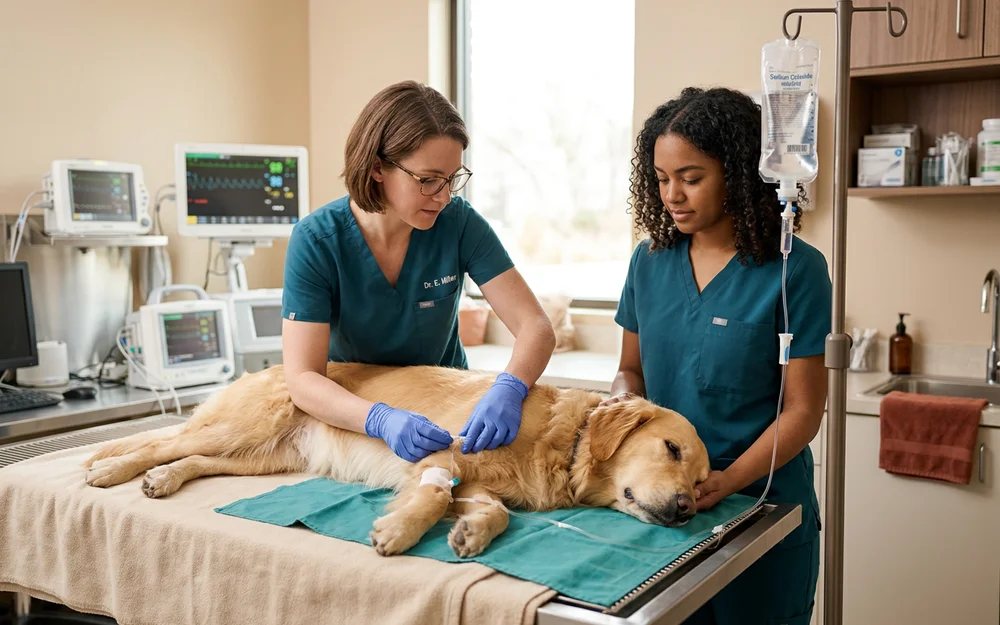
For everything else — a swallowed object, symptoms that have started, or a dog who is simply not right — contact us immediately. Tell us what was eaten if you know, when, and what you are seeing. We will triage the case and get imaging arranged.
We would far rather hear from you an hour too early than a day too late.