The procedure in plain terms
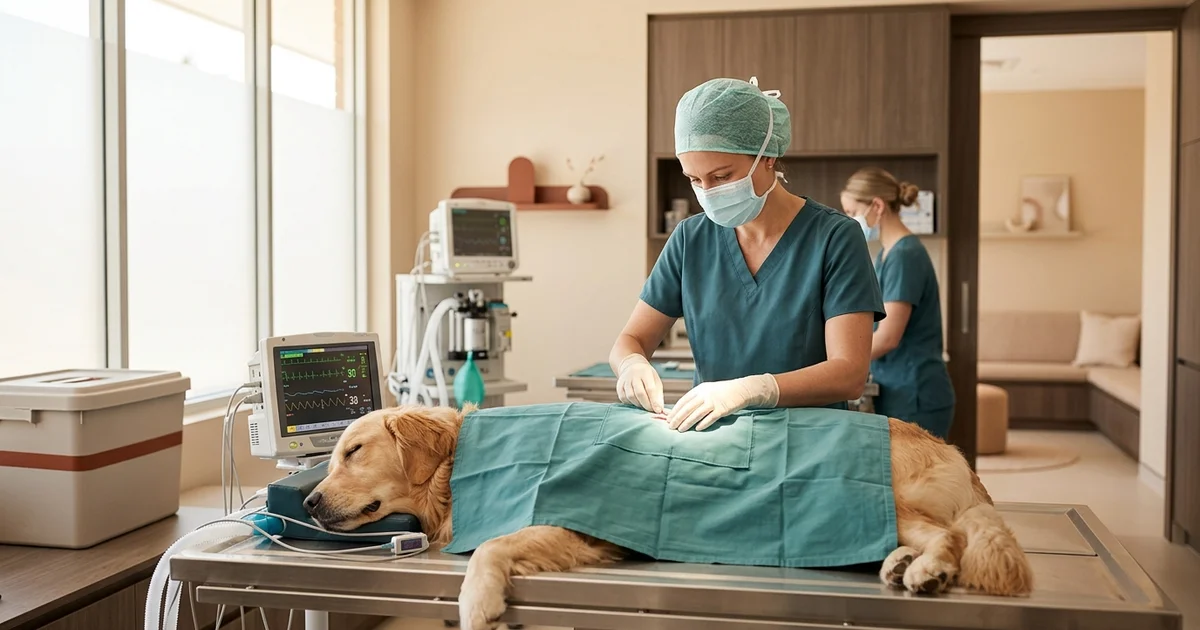
A cystotomy is a surgical incision into the urinary bladder. The word simply means “opening the bladder” — it does not describe why, which is why the same term covers stone removal, tear repair, biopsy, and mass excision.
In the overwhelming majority of cases the reason is uroliths: bladder stones that have formed in the urine and are now grinding against the bladder lining every time your dog moves. Our bladder stone surgery service is built around that scenario.
Step by step
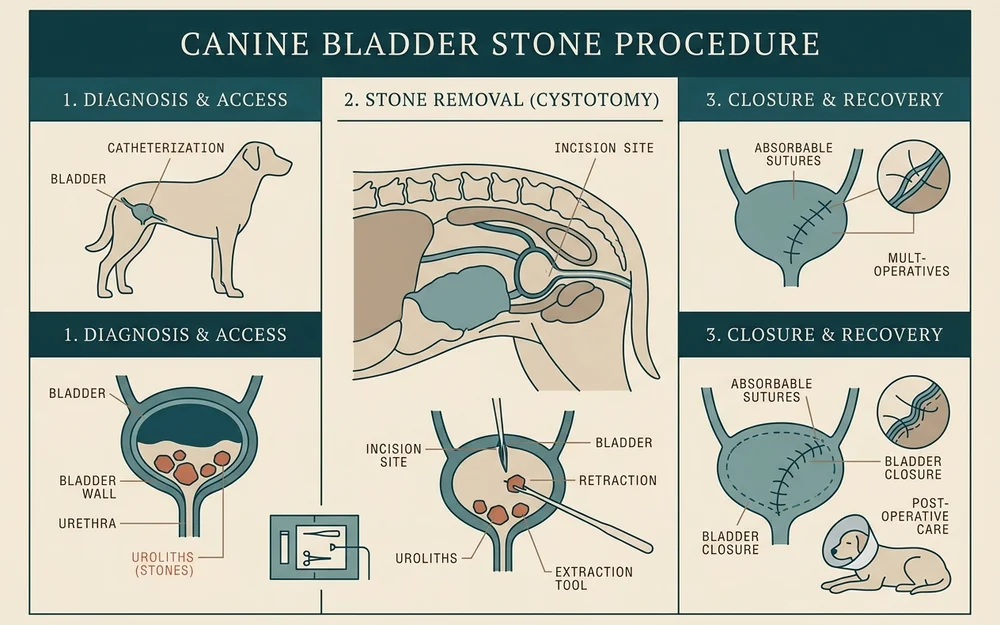
Preparation. Urinalysis and culture identify infection and crystal type. Imaging establishes how many stones there are and where they sit. Pre-anesthetic blood screening checks kidney function in particular, because a partially obstructed dog can arrive with elevated values that change the anesthetic plan.
The abdominal approach. A midline incision exposes the bladder, which is then isolated with moistened swabs so that urine and stones cannot contaminate the abdominal cavity when it is opened.
The bladder incision. The bladder is opened on its ventral surface, where the blood supply is least dense. This minimises bleeding and gives clear access to the interior.
Stone retrieval. Every visible stone is removed, and the bladder interior is inspected and flushed to catch smaller fragments hiding in the folds of the lining.
Retrograde flushing. A urinary catheter is passed and sterile fluid is flushed backwards along the urethra, pushing any fragment sitting there back into the bladder to be retrieved. This step is easy to skip and is the most common reason a dog needs a second surgery within months. It is standard in our procedure.
Closure. The bladder wall is closed with fine absorbable suture in a pattern designed to keep knots out of the bladder interior. Suture material exposed inside the bladder acts as a nucleus for a new stone to form around, so the closure technique is a genuine recurrence-prevention measure rather than a technicality.
The surgery has two jobs.
Remove today’s stones, and make tomorrow’s less likely. Flushing and closure technique are the second job.
What happens to the stones
The retrieved stones are sent for analysis. This is optional and it is the add-on we recommend most consistently, because the result determines the entire prevention strategy.
Struvite stones frequently form secondary to a urinary tract infection and often respond to a therapeutic diet combined with treating the infection. Calcium oxalate uroliths do not dissolve and are prevented instead with a urine-diluting diet and high water intake. Those are completely different plans, and without analysis the recommendation is a guess.
Recovery in brief
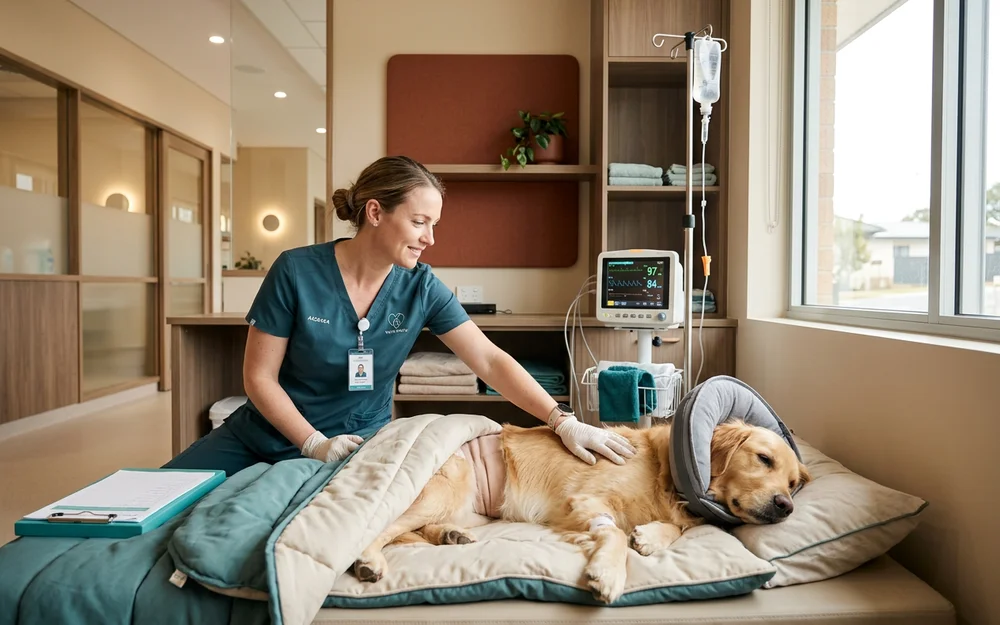
Most dogs go home the same evening. Blood-tinged urine for three to five days is expected and should lighten each day — heavy bleeding, clots, or an inability to urinate needs an immediate call.
Water should be freely available and actively encouraged. Dilute urine is the simplest form of stone prevention there is. Activity is restricted for two weeks while the bladder wall and abdominal incision heal, and the complimentary healing evaluation at 10 to 14 days confirms everything has closed properly.
Non-stone cystotomy
The same surgical approach handles other bladder problems: repairing a traumatic tear after a road accident, taking a deep tissue biopsy of the bladder wall, or excising a benign bladder-wall mass. These start at $900 and carry the identical safety and monitoring protocol.
If your dog is straining, urinating frequently in small amounts, or passing blood, an assessment is the sensible next step — and if surgery turns out not to be needed, we will say so.