The short answer
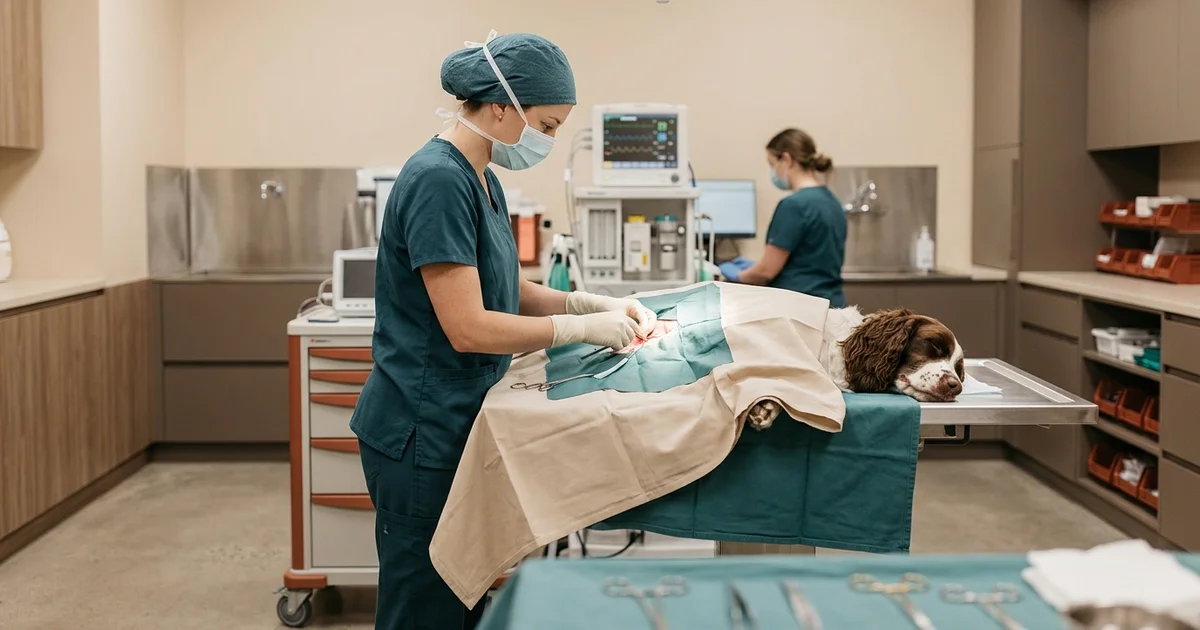
Dog bladder stone surgery — a cystotomy — starts at $950 through our network in Wilmington. Corporate referral hospitals in the same corridor routinely quote $2,500 to $4,000 for the identical procedure.
Owners regularly arrive with a three-thousand-dollar estimate and assume the difference must reflect something clinical. It does not. This page walks through the whole operation, what the price includes, what changes it, and how to compare quotes properly.
For the full service detail, see our bladder stone surgery service.
What a cystotomy is
A cystotomy is a surgical incision into the urinary bladder. In most cases we perform it to retrieve uroliths — bladder stones — that have formed in the urine and are now grinding against the bladder wall with every movement your dog makes.
Urolithiasis is genuinely painful, and dogs hide it well. The signs owners notice are behavioural: straining in the yard for longer than usual, asking to go out more often, accidents indoors from a house-trained dog, or blood-tinged urine on light paving.
Producing nothing at all is an emergency.
A dog straining without passing any urine may have a complete urethral obstruction. That backs pressure into the kidneys and becomes life-threatening within about a day. Go to the nearest emergency hospital immediately.
The full procedural walkthrough
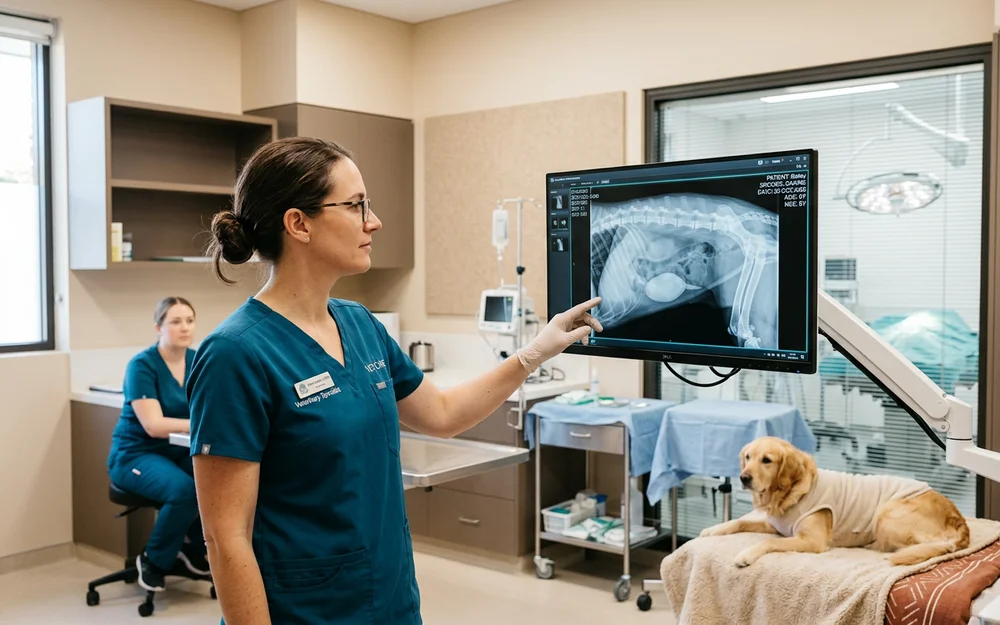
1. Diagnosis. Urinalysis and culture identify infection and crystal type. Radiographs or ultrasound confirm how many stones there are, how large, and exactly where they sit — including any that have already moved into the urethra.
2. Pre-anesthetic screening. Blood screening pays particular attention to kidney values, because a partially obstructed dog can present with elevated BUN and creatinine that materially change the anesthetic plan.
3. Approach. A midline abdominal incision exposes the bladder, which is isolated with moistened swabs so that urine and stones do not contaminate the abdomen.
4. The cystotomy incision. The bladder is opened in its least vascular area, on the ventral surface, to minimise bleeding.
5. Stone retrieval. Every visible stone is removed and the bladder interior is inspected and flushed.
6. Retrograde urethral hydropropulsion. A catheter is passed and sterile fluid is flushed backwards up the urethra, pushing any fragment sitting there back into the bladder where it can be retrieved. Skipping this step is the single most common reason a dog is back in surgery within months, and it is included in our price rather than charged as an extra.
7. Bladder mucosal closure. Fine absorbable suture — Monocryl or PDS — in a pattern that keeps knots out of the bladder lumen. Exposed suture material inside the bladder becomes a nucleus around which a new stone forms, so this detail matters more than it sounds.
8. Recovery. Continuous monitoring through to full consciousness. Most dogs go home the same evening.
The cost breakdown
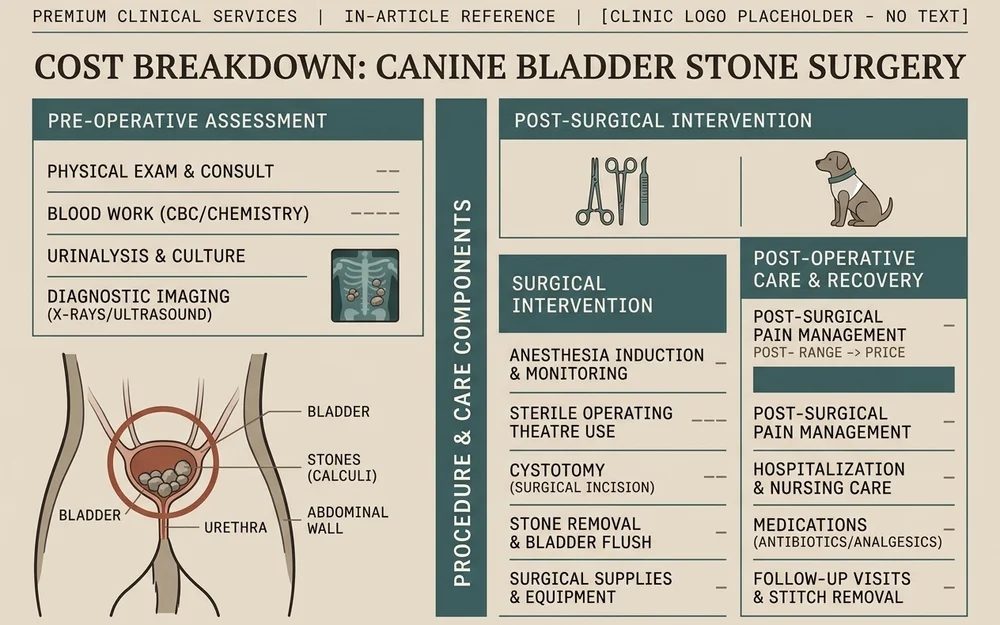
| Procedure | Our price | Typical Wilmington referral quote |
|---|---|---|
| Urolith extraction package (cystotomy) | From $950 | $2,500 – $4,000 |
| Non-stone cystotomy (tear repair, biopsy, wall mass) | From $900 | $2,500 – $3,500 |
| Stone analysis | Quoted separately | Often bundled at a markup |
| Follow-up cystogram | Quoted separately | Quoted separately |
Included in the $950 package
Pre-anesthetic blood screening · urinalysis · anesthesia · continuous SpO2, ECG, blood pressure and temperature monitoring · the cystotomy · complete stone retrieval · retrograde urethral hydropropulsion · careful bladder mucosal closure · home-recovery medications · structured discharge checklist · 24/7 recovery text line · complimentary 10-to-14 day healing evaluation.
What changes the price
Stone burden. A bladder containing thirty small stones takes longer to clear thoroughly than one containing two.
Urethral involvement. Stones lodged in the urethra, particularly in male dogs where the urethra narrows at the os penis, require more work to flush back.
Your dog’s condition on arrival. A partially obstructed dog with elevated kidney values needs more support before and during surgery than a stable one.
Laboratory work. Stone analysis is the main add-on, and it is the one we recommend most consistently — see below.
Why stone analysis is worth the money
The surgery solves today’s problem. Stone analysis is what stops the same surgery happening again in eighteen months.
Struvite stones are frequently secondary to a urinary tract infection and often respond to a therapeutic diet plus treatment of the underlying infection. Calcium oxalate uroliths do not dissolve at all and require surgical removal, with prevention resting on a urine-diluting diet and generous water intake.
These are completely different prevention strategies. Without knowing which type your dog forms, the diet recommendation is guesswork.
Post-operative recovery
Mild, gradually decreasing blood-tinged urine for three to five days is expected after bladder surgery. It should lighten each day rather than intensify. Heavy fresh bleeding, clots, straining without producing urine, or an inability to urinate needs an immediate call.
Activity is restricted for about two weeks while the bladder wall and abdominal incision heal. Water should be freely available and encouraged — dilute urine is the simplest recurrence prevention there is.
The complimentary healing evaluation at 10 to 14 days checks the incision and confirms recovery. Where there is any doubt about complete clearance, a follow-up cystogram confirms the bladder is empty.
Comparing quotes properly
Ask any practice quoting you these five questions:
- Is pre-anesthetic bloodwork included or optional?
- Is retrograde urethral flushing part of the procedure or an add-on?
- Which parameters are monitored during anesthesia, and by whom?
- Is stone analysis included, and if not, what does it cost?
- Is the follow-up recheck free?
A quote that skips the flushing step is quoting a different operation, and one with a materially higher recurrence rate.
Booking
We accept cash, credit card, and CareCredit. Urgent cases across the Brandywine Valley are scheduled within days.
Send us your dog’s breed and age, the symptoms you are seeing, and any imaging or urinalysis already done, and we will come back with a realistic figure and a date. Request a quote, or read more about coverage and access on our dog surgery in Wilmington page.