Two stones, two completely different plans
Most canine bladder stones fall into one of two types, and the distinction is not academic. It determines whether your dog can avoid surgery, what diet they go onto afterwards, and how likely the whole thing is to happen again.
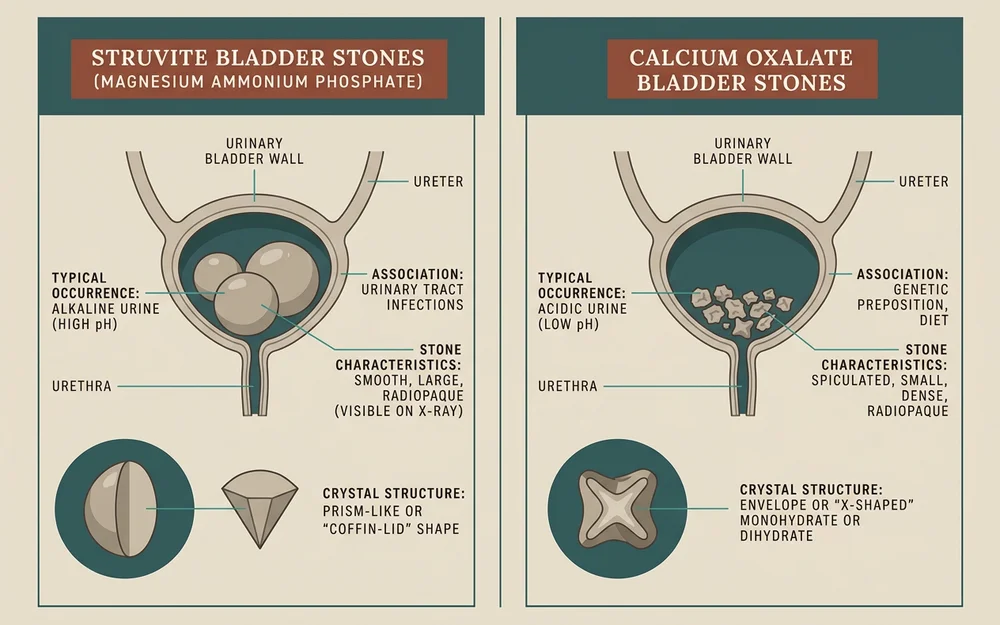
| Struvite | Calcium oxalate | |
|---|---|---|
| Chemical name | Magnesium ammonium phosphate | Calcium oxalate monohydrate / dihydrate |
| Urine pH | Forms in alkaline urine | Forms in acidic urine |
| Common trigger | Urinary tract infection | Metabolic; breed predisposition |
| More common in | Female dogs | Male dogs, small breeds |
| Dissolves with diet? | Often, over several weeks | No — never |
| Treatment | Diet + treat infection, or surgery | Surgery |
| Prevention | Prevent and treat UTIs, targeted diet | Urine-diluting diet, high water intake |
Struvite: the one you might avoid operating on
Struvite stones in dogs are usually secondary to a urinary tract infection. Certain bacteria produce an enzyme that raises urine pH, and in that alkaline environment magnesium, ammonium, and phosphate precipitate out and aggregate.
Because the driver is chemical rather than structural, removing the driver often removes the stone. A therapeutic dissolution diet acidifies the urine and reduces the mineral substrate, and antibiotic treatment clears the infection. Over several weeks, many struvite stones dissolve entirely.
The caveats are real. Dissolution takes weeks, during which your dog still has stones and may still be uncomfortable. It requires strict dietary compliance — no treats, no table scraps, nothing else in the bowl. And it is not appropriate if a stone is large enough to risk obstructing the urethra during the process.
Calcium oxalate: surgical, without exception
Calcium oxalate uroliths form in acidic urine and, unlike struvite, there is no diet that will dissolve them. Once they exist, the only way out is surgery.
They are more common in male dogs and in certain small breeds, and they are increasingly the more frequent type we see — partly because diets formulated to prevent struvite acidify the urine, which shifts the risk toward oxalate.
Because they cannot be dissolved, prevention after removal matters more here than for any other stone type. The strategy is dilution: a diet designed to increase water turnover and reduce urinary calcium and oxalate, plus every practical measure to get more water into your dog.
Same symptoms, opposite treatments.
This is exactly why we send removed stones for analysis. Prescribing a prevention diet without knowing the type is guesswork, and guessing wrong can accelerate the next stone rather than prevent it.
Practical prevention, whichever type
Water is the common factor. Dilute urine cannot supersaturate, and supersaturation is where every stone starts. Multiple water bowls, a water fountain if your dog prefers moving water, and wet food or water added to dry food all help.
Frequent urination. A dog who holds urine all day concentrates it and gives crystals longer to aggregate. More toilet opportunities genuinely reduce risk.
Stick to the prescribed diet. Therapeutic urinary diets are formulated precisely. Treats, chews, and table scraps undo the formulation, and owners are routinely surprised by how much difference a daily biscuit makes.
Periodic urinalysis. A returning infection or a shift in urine pH shows up on a urine sample long before a stone shows up on a radiograph.
If your dog already has stones
Bladder stone surgery starts at $950 through our network and is normally scheduled within days. Stone analysis is quoted separately, and it is the add-on we recommend most consistently, because it is the difference between treating this episode and preventing the next one.
If your dog is straining and producing no urine at all, that is an emergency — go to your nearest emergency hospital immediately.