Why this question comes up
Some practices in the region market laser surgery as a premium option for lump removal, and owners reasonably assume the more expensive, more technological choice must be the better one.
Sometimes it is. Frequently it is not. Here is the honest comparison, and where our mass removal approach lands.
What each method actually does
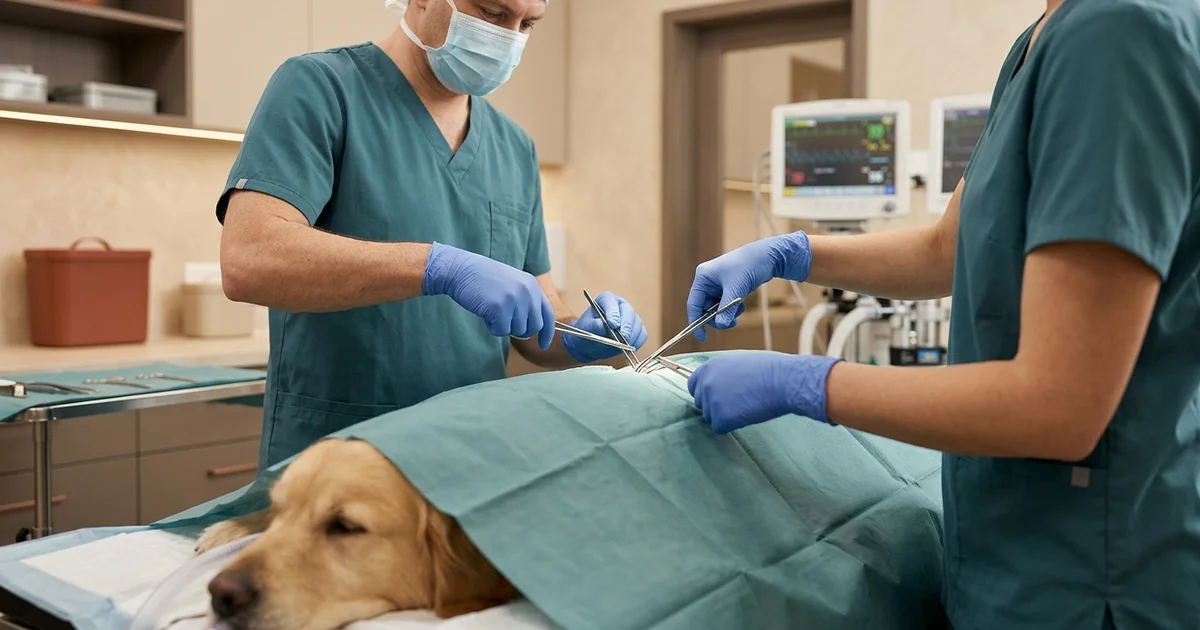
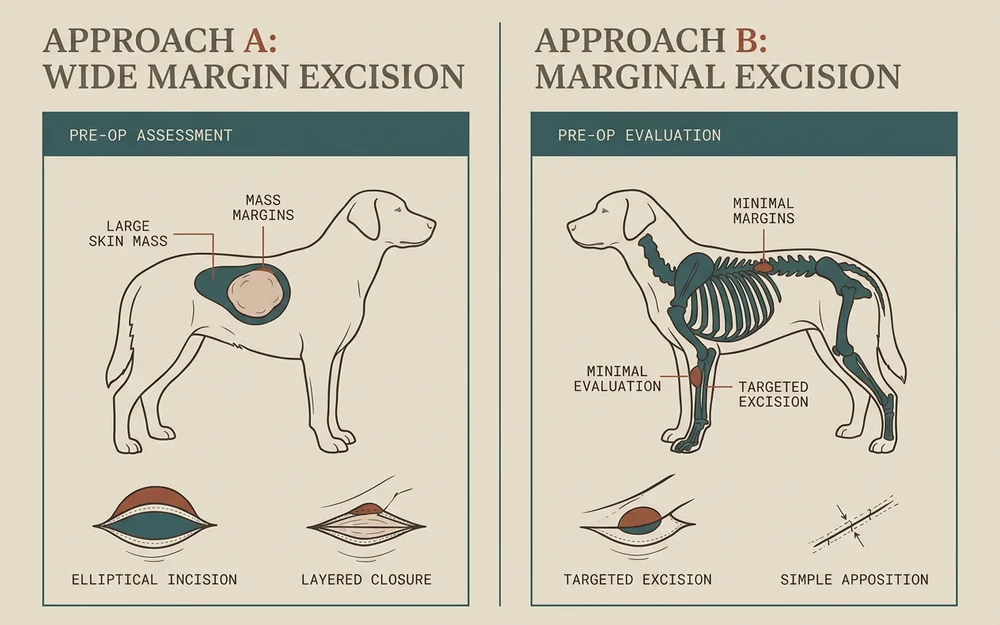
Scalpel excision cuts tissue mechanically. The cut is clean, the tissue at the edge is undamaged, and bleeding is controlled separately with ligatures or electrocautery.
Laser excision uses a focused beam of light energy to vaporise tissue. As it cuts it also seals small blood vessels and nerve endings, which reduces bleeding and can reduce post-operative swelling.
The trade-off table
| Scalpel excision | Laser excision | |
|---|---|---|
| Bleeding during surgery | Controlled with ligatures and electrocautery | Reduced — vessels sealed as it cuts |
| Margin assessment | Clean edges, straightforward for the pathologist | Thermal artefact at the edge can obscure margins |
| Speed on vascular tissue | Slower where bleeding is significant | Faster |
| Post-op swelling | Normal | Sometimes less on superficial masses |
| Suitable for suspected malignancy | Yes — the standard | Less suitable where margins must be assessable |
| Typical cost | Standard | Often higher |
Why margins decide it
For a mass that might be malignant, the single most important output of the surgery is not just the removal — it is the pathologist’s report on whether the tumor reached the edge of the removed tissue.
That report depends on being able to see the edge clearly. A laser cuts by heating tissue, and that heat produces a zone of thermal artefact at the cut surface. On a benign lipoma nobody cares. On a suspected mast cell tumor, where the entire question is whether the margins are clean, it can genuinely make the report harder to interpret.
The purpose of a mass removal is not to remove the mass. It is to remove the mass with margins you can trust.
Where a laser genuinely helps
Laser has real applications. Small, superficial, confirmed-benign skin growths on a highly vascular area — some oral lesions, small warty growths in awkward places — can be removed quickly with minimal bleeding and minimal swelling. Where the diagnosis is already established and margins do not need assessing, that is a fair use.
What it does not do is make an ordinary lump removal safer, less painful, or better healing in any way that shows up in the outcome.
What we do instead
We use scalpel excision for the great majority of canine masses, with electrocautery for haemostasis where bleeding needs controlling. That combination gives us the bleeding control that makes lasers attractive, without compromising the margins.
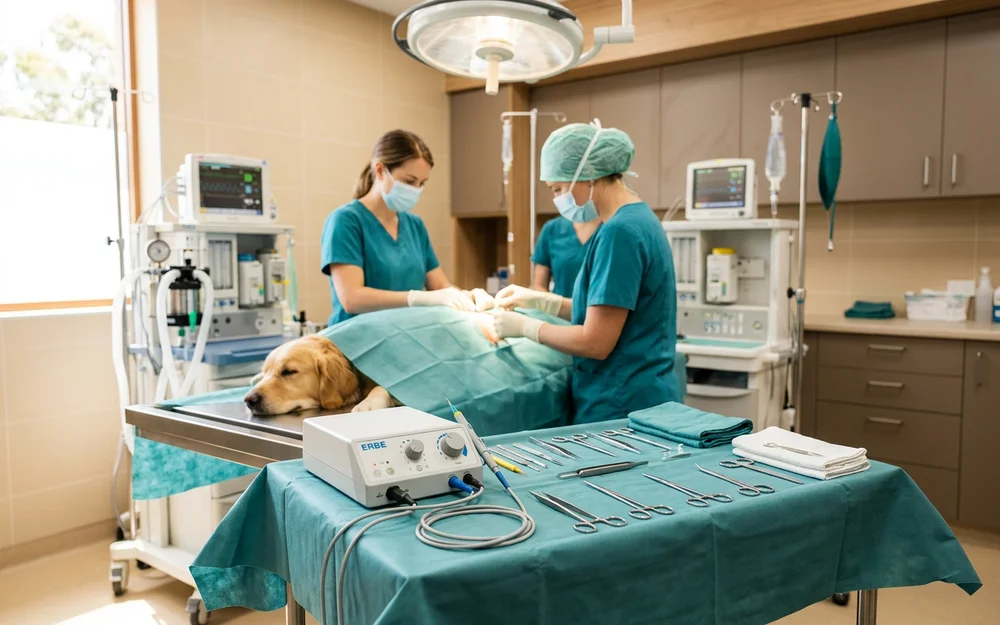
Every removal includes pre-anesthetic blood screening, continuous multi-parameter monitoring, and a cosmetic subcuticular closure — and every quote explains which parts are clinically necessary rather than optional.
If another practice has quoted you more for laser removal, ask them one question: how will the thermal margin affect the histopathology report? A good answer will tell you a lot about whether the recommendation is clinical or commercial.