
Who this affects
Pyometra affects unspayed female dogs. If your dog is spayed, she cannot get it, and you can stop reading.
If she is not spayed and has had a season in the last two months, this is worth five minutes of your time. Pyometra kills dogs whose owners did not recognise it, and the early signs are easy to attribute to something minor.
Our emergency pyometra surgery treats these as same or next-day priority cases for exactly that reason.
The classic picture
A female dog finished a season somewhere between two and eight weeks ago. She is now:
- Lethargic — flatter than usual, less interested, sleeping more
- Off her food, or eating noticeably less
- Drinking and urinating far more than usual — often the first thing an owner genuinely notices
- Vomiting, in some cases
- Producing a foul-smelling discharge from the vulva — or producing nothing at all
- Showing a distended or tender abdomen
The increased thirst is the sign most worth committing to memory. Toxins from the infection affect the kidneys’ ability to concentrate urine, so the dog drinks and urinates more. Owners frequently mention it as an afterthought.
The version with no discharge is worse
No discharge does not mean no pyometra.
In closed pyometra the cervix is sealed, so nothing drains out. The pus accumulates under increasing pressure with no external sign, and these dogs become critically ill faster.
In open pyometra the cervix is open and infected material drains. It smells terrible, which is unpleasant but genuinely useful — it gets owners to a vet, and it relieves some of the pressure.
In closed pyometra there is no discharge, no obvious sign, and no pressure relief. Owners present later because there was nothing to see, and by then the uterus is severely distended and the dog is systemically unwell. Uterine rupture is a real risk.
So if your intact female is unwell after a season and there is no discharge, that raises the concern rather than removing it.
What is happening inside
With each heat cycle the uterine lining thickens progressively, a change called endometrial hyperplasia. Thickened, glandular tissue in the hormonal environment following a season is an ideal medium for bacteria that have travelled up from the vagina.
The uterus fills with pus. As it distends, bacterial toxins enter the bloodstream, producing sepsis and endotoxemia. The kidneys are affected, blood values shift, and the dog deteriorates. This is not a slow condition.
What to do
If your intact female is unwell after a recent season, contact us immediately. Tell us when the season ended, what symptoms you are seeing, whether there is any discharge, and how much she is drinking.
If she is collapsing, has a rigid painful abdomen, or cannot keep water down, go to your nearest emergency hospital right away for stabilisation.
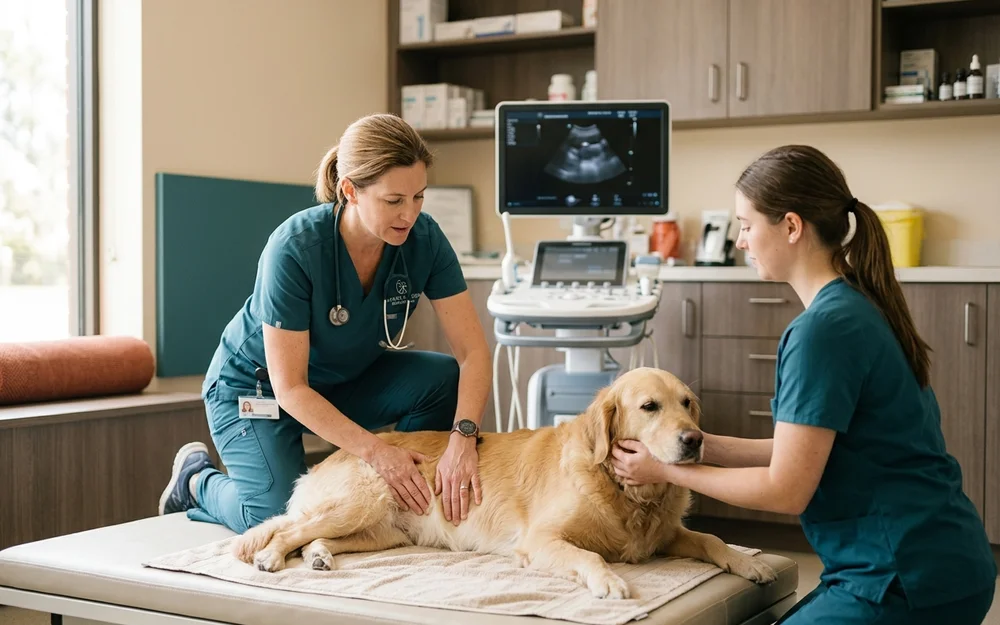
Diagnosis is straightforward — history, examination, bloodwork, and imaging. Treatment is an emergency ovariohysterectomy, which removes the infected uterus and both ovaries. It starts at $1,100 through our network, well below emergency hospital pricing, and it is curative: because the uterus is gone, pyometra cannot happen again.
The prevention that actually works
Spaying a female dog you do not intend to breed from removes the risk entirely. Our Premium Spay packages use private-hospital standards — pre-anesthetic blood panels, continuous monitoring, multi-modal pain control, and cosmetic subcuticular closures with no external staples — from $245.
That is a fraction of what an emergency pyometra costs, in every sense.