
The short answer
Canine splenectomy in Delaware starts at $1,500 through our network. Referral hospitals in the same region routinely quote $3,500 to $6,000.
Splenic disease is one of the harder diagnoses to receive, and the estimate lands at the worst possible moment. This page sets out what the figure covers, what sits on top, and what genuinely changes it. For clinical detail, see our splenectomy service.
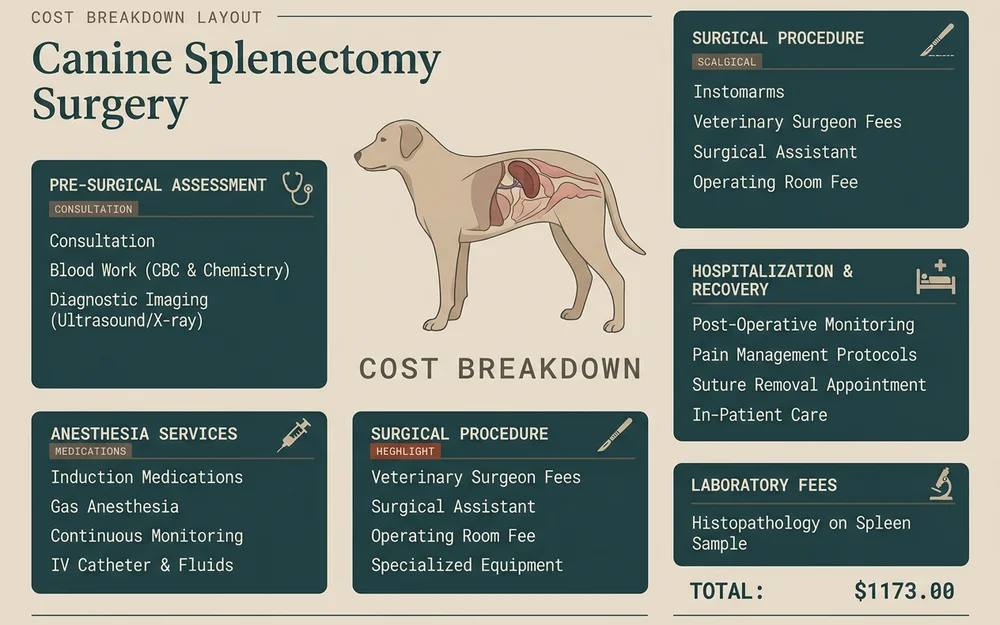
What the $1,500 includes
Every splenectomy covers:
pre-anesthetic blood screening including baseline PCV · anesthesia · continuous Lead II ECG monitoring throughout · continuous SpO2, blood pressure and temperature monitoring · hilar vessel ligation with surgical hemoclips · full abdominal exploratory where indicated · post-operative PCV and lactate monitoring · home-recovery medications · structured discharge checklist · 24/7 recovery text line · complimentary 10-to-14 day healing evaluation.
The ECG monitoring matters more here than in any other soft tissue procedure. Splenic disease is strongly associated with ventricular premature contractions, which can appear during surgery or in the 24 to 48 hours afterwards. It is included rather than offered as an upgrade.
What is quoted separately
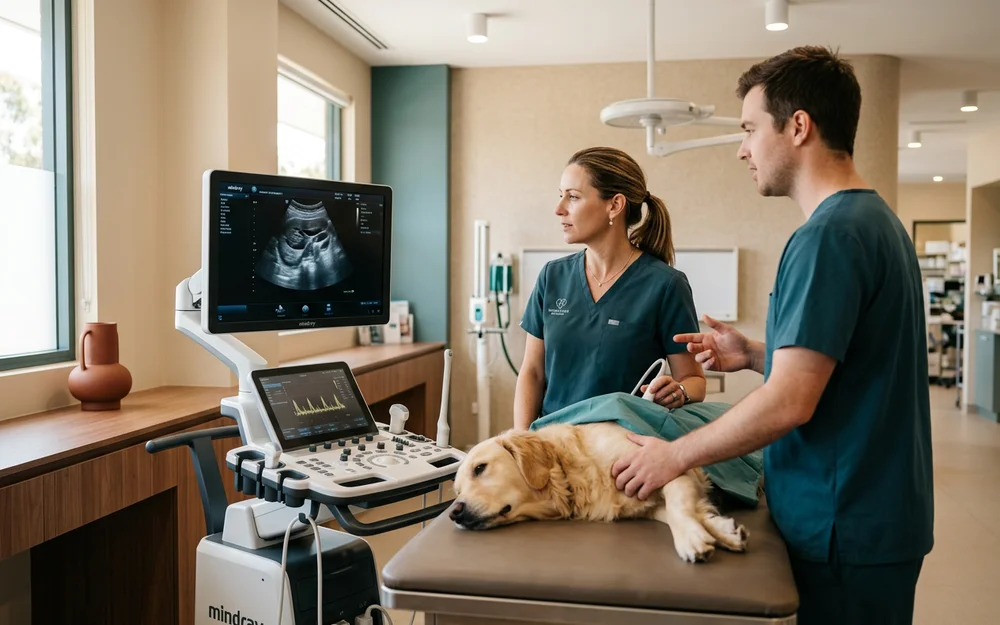
Abdominal ultrasound to characterise the mass and examine the liver — the most common site of spread if the mass is malignant.
Thoracic radiographs to check for pulmonary metastasis before committing to surgery.
Histopathology of the removed spleen. Strongly recommended, because it is the only way to know whether the mass was benign or malignant, and that determines everything that follows.
Blood transfusion, where a dog has lost enough blood into the abdomen that the packed cell volume warrants it.
What changes the price
Emergency versus planned. A dog who collapses with hemoperitoneum needs stabilisation, possible transfusion, and a faster, more demanding surgery. A mass found incidentally on ultrasound in a well dog can be staged and planned properly.
Size and adhesions. A very large splenic mass, or one that has adhered to surrounding structures, takes longer to free safely.
Additional findings. If the abdominal exploratory reveals a liver lesion that needs biopsying, that is discussed and quoted at the time rather than added silently.
The fifty-fifty context
Roughly half of canine splenic masses turn out to be benign, and no imaging can reliably tell you which half your dog is in before surgery.
That matters financially as well as emotionally, because owners weighing a $1,500 estimate against a feared cancer diagnosis are often really asking whether the money is worth spending on a dog who may not have long.
The honest framing is that surgery is the diagnosis as well as the treatment. Half of these dogs are cured by the operation and go on to live entirely normally. Declining it does not avoid a bad diagnosis; it avoids ever knowing, while leaving in place a mass that may bleed catastrophically.
Financing
We accept cash, credit card, and CareCredit. Splenic disease arrives without warning, and CareCredit spreads the cost across monthly payments. If cost is the barrier, tell us at the point of contact.
Getting a real figure
Send us your dog’s breed, age, and weight, whatever imaging or bloodwork has already been done, and whether they are currently stable or unwell. We will come back with a realistic range, what the diagnostics will add, and the soonest date we can offer.
Emergency splenic cases are treated as same or next-day priorities. If your dog has collapsed, has pale gums, or is weak, go to your nearest emergency hospital immediately for stabilisation.