The short answer
Traumatic canine fracture repair in Wilmington starts at $1,800 through our network. Referral hospitals in the region routinely quote $3,500 to $7,000 for the same work.
Orthopedic surgery carries a substantial premium in corporate referral settings, and the implants and technique are identical. This page explains what the figure covers and what moves it. For the clinical detail, see our fracture repair service.
What the $1,800 covers
Every fracture repair includes:
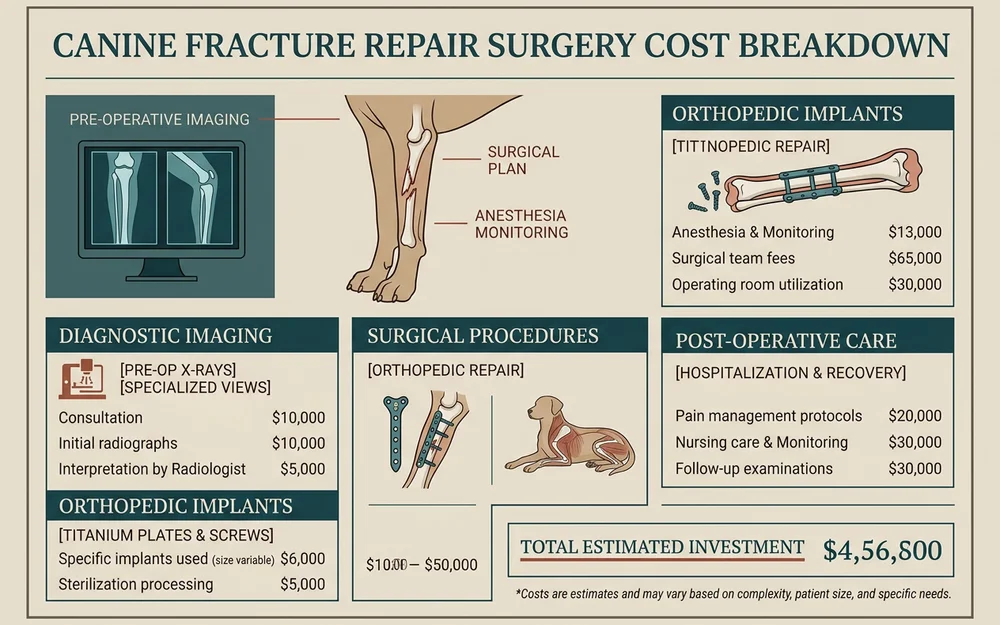
pre-anesthetic blood screening · anesthesia · continuous SpO2, ECG, blood pressure and temperature monitoring · open or closed reduction · internal fixation with plate and cortical screws, intramedullary pin, or K-wires as required · the implants themselves · immediate post-operative radiographs to confirm alignment · home-recovery medications · structured discharge checklist · complimentary healing evaluation.
What is quoted separately
Initial diagnostic radiographs. Orthogonal views to characterise the fracture before any surgical decision is made.
External fixator frames. Where a fracture is open, contaminated, or too comminuted for internal fixation, an external frame is used. The hardware is more expensive.
Serial recheck radiographs. Fracture healing is monitored over six to twelve weeks, and each recheck involves imaging. These are quoted as a series so you can budget for the whole course rather than being surprised each visit.
What moves the price
Fracture pattern. A simple transverse fracture of a single long bone is at the bottom of the range. A comminuted fracture in several pieces, or one extending into a joint surface, requires more time, more hardware, and more precision.
Hardware. A bone plate with eight stainless steel cortical screws costs substantially more than a single intramedullary pin. The choice is clinical, not commercial — we use what will hold that fracture, and we will explain why.
Which bone. Fractures below the elbow or stifle are generally more accessible than those in the femur or humerus, where more soft tissue has to be worked through.
Your dog’s size. Larger dogs need heavier hardware to withstand the loads their bodies place on it.
The recheck series matters
Owners occasionally ask whether the recheck radiographs are strictly necessary, given the dog is walking well.
They are, and the reason is exactly that. Dogs bear weight enthusiastically on bones that are nowhere near healed. Callus formation is only visible on imaging, and lifting activity restrictions on the strength of how a dog looks is how a fracture becomes a non-union — which requires revision surgery at considerably greater cost.
Budget for the series at the outset. It is part of the treatment, not an optional extra.
Financing
We accept cash, credit card, and CareCredit. Fracture repair is an unplanned expense that arrives at speed, and CareCredit spreads it across monthly payments. Tell us at the point of contact if cost is a constraint.
Most accident insurance policies cover traumatic fracture repair. We provide itemised estimates for insurers before surgery.
What we do not treat
Our orthopedic scope is strictly traumatic bone fracture repair. We do not perform TPLO, cruciate repair, or patellar luxation correction. If that is what your dog needs, we will tell you plainly rather than take on work someone else does better.
Next steps
If your dog was hit by a car, go to your nearest emergency hospital first for stabilisation. Once stable, send us the radiographs, your dog’s breed, age, and weight, and how the injury happened. We will come back with a realistic figure, the fixation approach we would recommend, and a date.