
First: is it definitely a fracture?
You know how easily a dog can hide a serious injury after a sudden fall or a bad landing. They might just refuse to put weight on the leg, making a fracture and a severe sprain look identical from across the room. We always start with radiography at our fracture repair service because images confirm exactly what we are dealing with.
This step separates the standard treatment plans from the truly effective ones.
Let’s look at the data behind fracture repairs, the factors that dictate surgery, and the practical steps you should take today.
If your dog was hit by a car, go to an emergency hospital first.
Chest injury, abdominal bleeding, and shock are what kill in the first hours. The leg is visible and alarming, but it is rarely the priority. Get your dog stabilised, then we can plan the repair.
The four factors that decide it
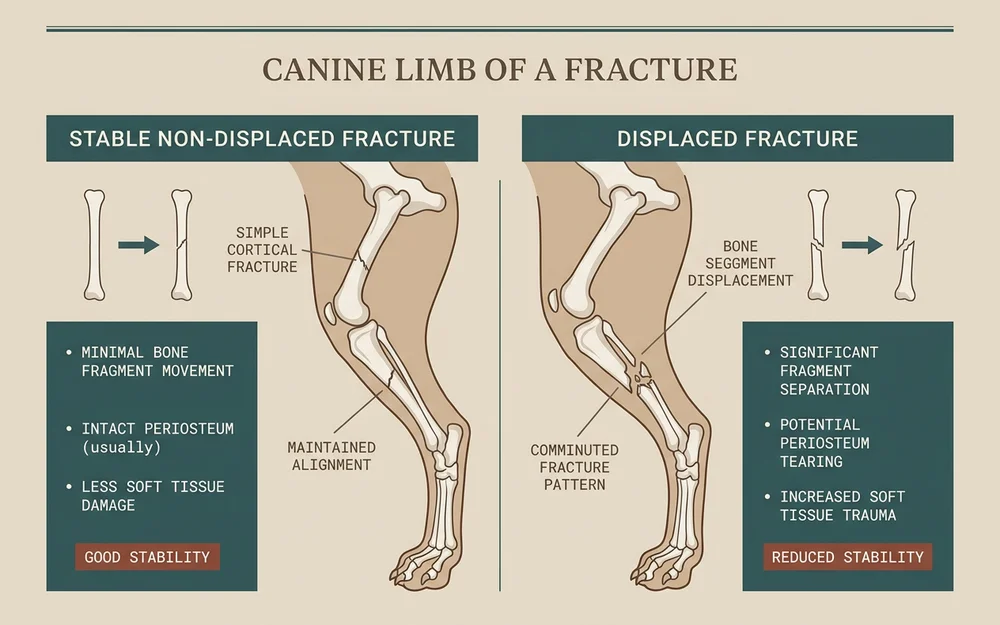
If you are wondering, does dog fracture need surgery, we evaluate four distinct factors to find the answer. These variables include displacement, the number of bone fragments, joint involvement, and whether the skin is broken. We evaluate each of these elements using guidelines from organizations like the American College of Veterinary Surgeons. A clear understanding of these factors helps you make an informed choice for your pet.
1. Displaced or non-displaced fractures
A non-displaced fracture means the bone ends are still in the correct position. The bone is cracked but has not shifted out of alignment. Treating a displaced fracture dog case means the bone ends have moved, which almost always dictates surgery. A bone left to heal crooked stays crooked, leading to lifelong mobility issues. We utilize surgical plates and screws to realign these displaced bones permanently.
2. Simple or comminuted breaks
Simple fractures consist of exactly two bone fragments. Comminuted fractures mean the bone has shattered into three or more pieces. Reassembling several pieces requires advanced hardware like locking compression plates rather than a simple cast. This internal hardware provides the rigid stability needed for the bone to fuse back together correctly.
3. Does it involve a joint?
A fracture that extends into a joint surface must be reconstructed perfectly. The American College of Veterinary Surgeons notes that even a single millimeter of misalignment in a joint surface leads to severe arthritis. Joint-involving fractures are exclusively surgical cases. We take extreme care to restore the joint to its exact anatomical shape to prevent future pain.
4. Open or closed injuries
An open fracture has broken through the skin, exposing the bone to environmental bacteria. These injuries are medical emergencies that require thorough cleaning within the first eight hours to prevent severe bone infections. Vets frequently manage these with external fixation so that no hardware is implanted directly into a contaminated site. Closed fractures keep the skin intact, which significantly lowers the immediate risk of infection.
When a splint is genuinely reasonable
When weighing a dog broken bone splint vs surgery, location matters immensely. A splint or cast only works effectively for stable, non-displaced fractures located below the elbow or the stifle. Any break above these joints cannot be immobilized properly and will require surgery. We only recommend external coaptation when several specific conditions are met simultaneously.
- The fracture is stable and non-displaced: The bone must already be perfectly aligned.
- Location matters: It must be below the elbow or the stifle, where a cast can immobilize the joints above and below the break.
- The dog is young: Puppies have soft growth plates and high healing potential, often recovering in four to eight weeks compared to the typical eight to twelve weeks for adults.
- Genuine confinement: The owner must deliver strict crate rest for the entire healing period.
- Regular bandage checks: The wrap must be checked weekly for sores and slippage.
That last point requires serious attention from the owner. Poorly managed bandages cause pressure sores that are considerably worse than the original fracture. A cast that slips is holding nothing and allows the bone to shift out of place.
We also have to consider the breed and exact bone involved. Small and toy breed dogs have a notoriously poor blood supply in their lower legs. Studies show that attempting to splint a distal radius fracture in a toy breed results in a high failure rate, making surgical plating the standard recommendation for these tiny patients in the US.
Open versus closed reduction
Closed reduction realigns the bone ends without opening the fracture site, working externally under x-ray guidance. Open reduction exposes the site directly through an incision so the surgeon can rebuild complex fractures. We choose the method that offers the highest chance of a perfect functional recovery.
| Feature | Closed Reduction | Open Reduction |
|---|---|---|
| Technique | External manipulation using x-ray guidance | Direct surgical incision to access the bone |
| Blood Supply | Preserves the natural blood vessels around the break | Disrupts local tissue but allows for exact reconstruction |
| Best For | Simple, lower limb fractures in young dogs | Comminuted fractures, joint injuries, and trapped tissues |
| Hardware Used | Casts, splints, or external fixators | Internal locking plates, intramedullary pins, or K-wires |
Closed reduction preserves the blood supply around the fracture, which dramatically helps the healing process. This method requires specialized skill to align the bones perfectly from the outside.
Open reduction becomes mandatory when fragments must be positioned individually or when a joint surface needs reconstructing. Soft tissue sometimes gets trapped between the bone ends, making external realignment impossible. We rely on open reduction to place internal plates that hold complex fractures completely still during the eight to twelve weeks of recovery.
What we do and do not treat
Our clinic strictly repairs traumatic bone fractures. Specific stabilization techniques ensure proper healing for these major injuries.
- Plating and bone screws
- Intramedullary pinning
- K-wire placement
- External skeletal fixation
Elective orthopedic surgeries like TPLO or patellar luxation correction fall outside our specific scope. This is a deliberate limit rather than a gap in our capabilities.
Our traumatic fracture repair pricing starts at $1,800. US veterinary market data for 2026 shows that average dog fracture surgeries range from $2,000 to $5,000 depending on the complexity of the break and the hardware required. We provide transparent estimates upfront based on your dog’s specific radiographs.
A TPLO surgery treats a torn cranial cruciate ligament, which is a degenerative joint disease rather than a sudden broken bone. We point owners to trusted local specialists for these elective ligament repairs rather than stretching our primary focus.
What to do now
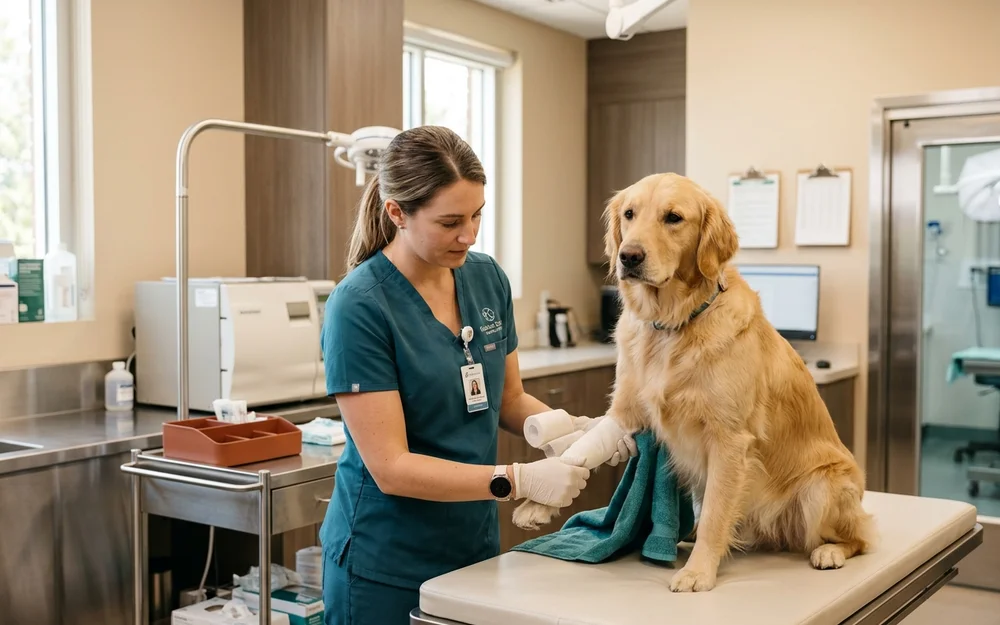
Get radiographs immediately to understand the true extent of the injury. Keep your dog strictly confined, do not attempt to splint the leg yourself, and never give human pain relief. We need accurate images before we can recommend a safe and effective treatment plan.
The ASPCA Animal Poison Control Center reports that human pain medications are highly toxic to pets. A single 200 mg tablet of ibuprofen can cause severe stomach ulcers and sudden kidney failure in a dog. You must rely exclusively on veterinary-prescribed pain control to keep your pet safe.
We will review the file and tell you whether this is a surgical fracture. A clear cost estimate and an explanation of the repair process will follow shortly after. Send your radiographs to us today so we can help you choose the best path forward.