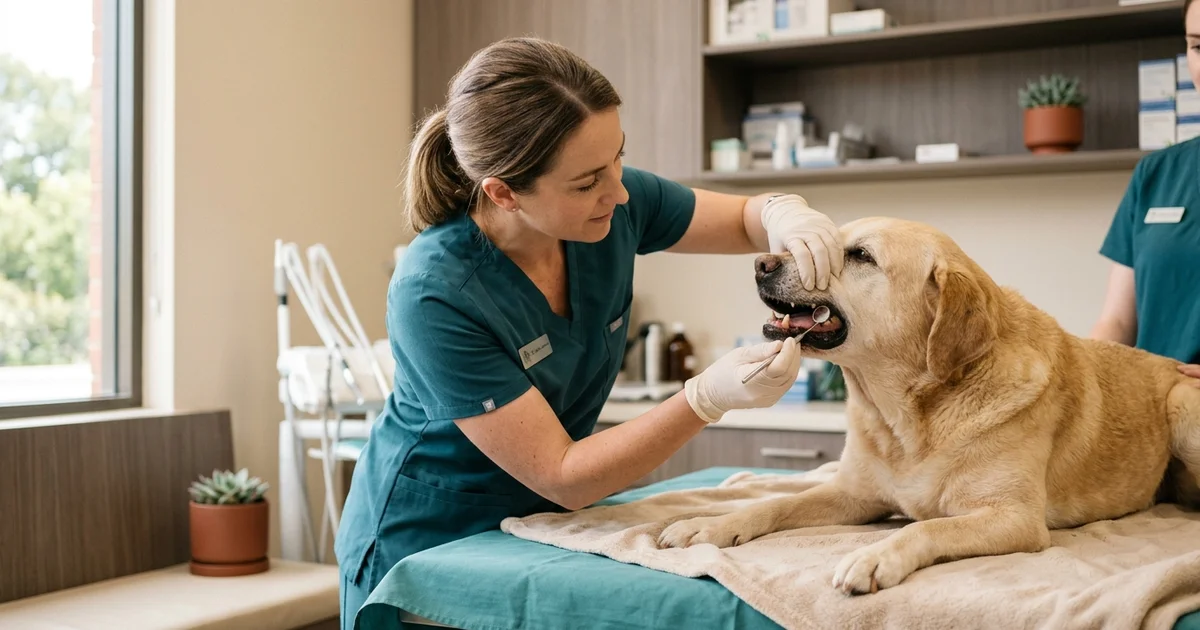
Why the estimate has two different numbers on it
Owners are frequently surprised that removing one tooth costs a fraction of removing another. It looks arbitrary from the outside. It is not — it reflects two genuinely different procedures.
Our dental and oral surgery service performs both, and this guide explains which teeth need which.
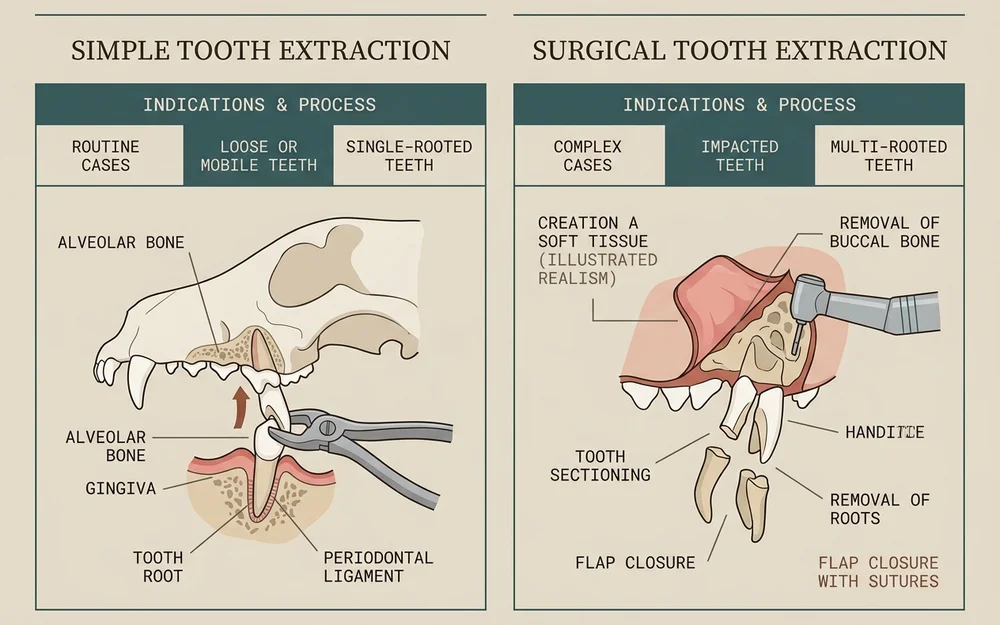
Simple extraction
A simple, or closed, extraction is used for single-rooted teeth — the incisors at the front, and in some cases the canines.
The periodontal ligament holding the tooth in its socket is gradually broken down with a fine dental elevator, working around the root a little at a time. Once the ligament has released, the tooth is lifted out intact. The socket is checked and, depending on the site, closed or left to granulate.
It is quick, and it is straightforward when the tooth is genuinely single-rooted and the root is intact.
Surgical extraction
A surgical, or open, extraction is required for multi-rooted teeth: the premolars, the molars, and in particular the carnassials — the large shearing teeth that are the workhorses of a dog’s mouth.
These teeth have two or three roots that diverge below the gumline. There is no direction in which the tooth can be lifted out whole; the divergent roots physically lock it in place.
The procedure runs:
- Raise a mucoperiosteal flap — the gum tissue over the site is incised and lifted away from the bone
- Remove a margin of alveolar bone with a dental burr, exposing the roots
- Section the tooth into individual root segments
- Elevate each root separately, working the ligament free on each one
- Curette the socket — subgingival curettage removes diseased tissue and infection
- Close the flap over the site with dissolvable suture
That is six steps against one, with specialised equipment and considerably more time. That is where the difference in the estimate comes from.
The word “surgical” is not a marketing term here. It describes a genuinely different operation.
Why cutting corners causes problems
A multi-rooted tooth removed without sectioning and without a flap tends to fracture. The crown comes away and a root fragment stays behind in the bone.
Retained root fragments are the most common cause of ongoing pain after an extraction performed elsewhere. They are frequently invisible on examination, because the gum heals over the top. The dog carries on eating, the owner assumes the problem was solved, and the fragment quietly maintains an infection in the jaw.
This is exactly why every extraction we perform includes digital intraoral dental radiography, both before to plan and after to confirm the root came out completely.
Nerve blocks and pain
Every extraction, simple or surgical, includes a regional nerve block. An infraorbital block numbs the upper jaw on that side; an inferior alveolar block numbs the lower.
Two benefits follow. With the region genuinely numb, the general anesthetic runs lighter, which is safer — particularly in the senior dogs who need most of this work. And the dog wakes without the pain surge that otherwise arrives as the anesthetic clears.
Multi-modal pain relief continues at home. Give it on schedule even if your dog seems fine.
What it costs, and what to ask
Canine dental procedures run from $150 to $950, depending on which teeth are involved and how many. That range includes anesthesia, pre-anesthetic bloodwork, continuous monitoring, nerve blocks, and dental X-rays. Complete cleanings start at $295.
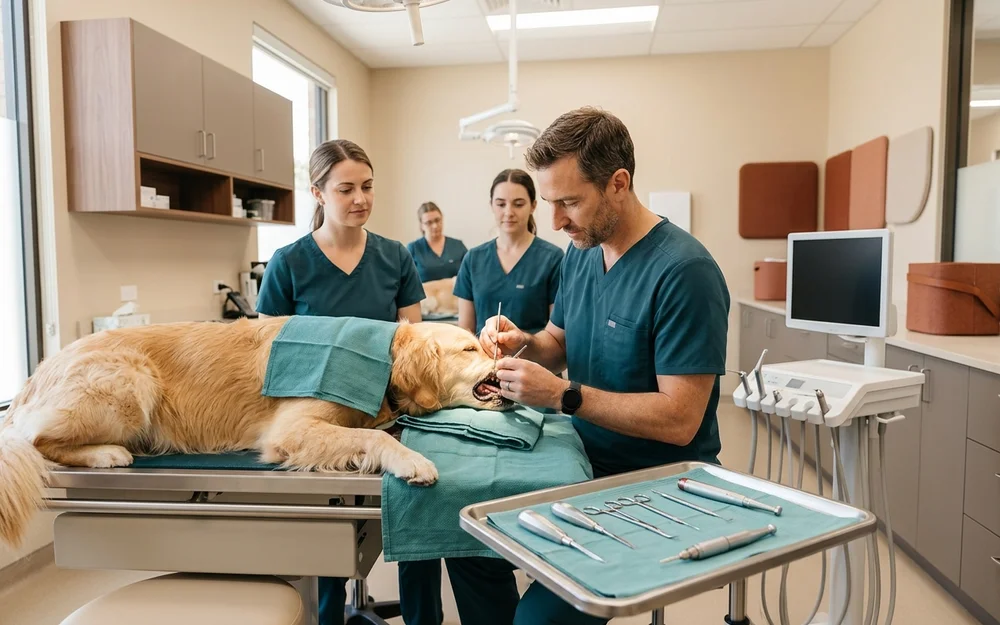
If you are comparing quotes, ask two questions: are dental X-rays included, and are nerve blocks included? A cheaper estimate that omits both is quoting for a different, and considerably worse, procedure.